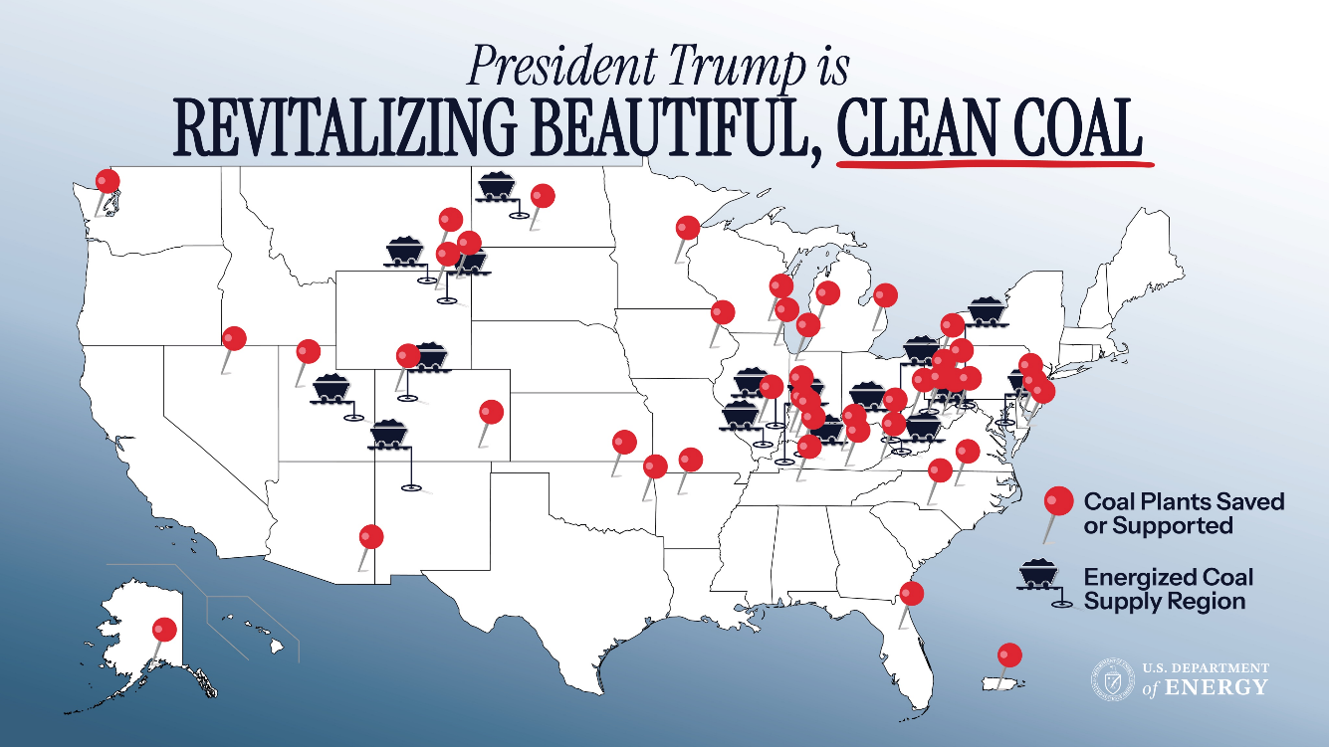
Leading off with a semi-joke, a couple of weeks ago, I saw this amusing yet serious post from the Trump Department of Energy. This X post says the administration saved 43 coal plants and helped build two more. At almost the same time, they released a fact sheet that puts the number at 45 saved plants – I guess that’s 43 plus 2. There are actually two coal plants under construction in the United States: a new 1.25 GW plant in Anchorage and a 1.6 GW plant at the West Virginia Energy Campus. Wow! A 205 MW plant is being restarted in Cumberland, Maryland.
Figure 1 Beautiful, Clean Coal🙄
Behind the Meter Generation Disadvantages
Ok, getting serious about data centers and powering them, I mentioned multiple times, including here and here, that data center developers are bringing their own power generation behind the meter because utilities and the bureaucracies and stakeholder groups move far too slowly to meet the loads with conventional grid and generation expansion. I explained that when data centers use behind-the-meter (BTM) power generation, they leave the most expensive variable load for the commoners to finance. That is the mechanism that tends to drive up rates by spreading the fixed cost of service, including generation and transmission capacity, across lower kWh sales compared to the status quo of the utility and grid supplying all the energy.
Data centers may still rely on the grid as backup for their behind-the-meter generation. In those cases, costs can rise for other customers as the ratio of required capacity (MW) to energy sales (MWh) increases. See the Regulatory Bureaucracy post for more details. Large-load customers, such as data centers, should pay substantial standby charges to cover these backup needs.
Behind-the-Meter Generation Advantages
There are advantages to behind-the-meter power generation that I hadn’t considered before. One of them is lower transmission, including costs for voltage transformers.
Another advantage for states with vertically integrated electricity markets is that BTM generation reduces customers’ risk. One fear, as I explained last week, is that the longevity of these large loads is a risky proposition for utilities to ramp up generation, transmission, and distribution when the loads could collapse someday due to a wide variety of factors:
- AI demand overestimation. AI is being poorly leveraged, if at all, in most businesses.
- Industry consolidation. There are seven major players[1] today, and I imagine it will shake out to only three or four someday. That will leave many GWs of lost load, maybe picked up elsewhere, but still, locally lost load.
- Computing efficiency improvements. The semiconductor industry has a long history of delivering more computing power with less energy.
- Algorithmic efficiency. The industry tends to focus on hardware, but software improvements can be equally disruptive. New model architectures, training techniques, and inference methods may reduce computing requirements by orders of magnitude.
- Technology obsolescence. History is filled with examples of technologies that appeared unstoppable before becoming obsolete: mainframes, minicomputers, pagers, and fax machines once dominated their markets. Utilities making 40-year infrastructure investments face the risk with data centers today. The internet exploded only ~25 years ago.
- Water constraints. Most data centers require massive amounts of water for evaporative cooling. What happens when they deplete the local water supply?
- Competition from foreign markets, although this is at least somewhat mitigated by data security requirements.
One way to avoid lost or greatly reduced data center load and stranded assets that would be paid by the remaining customers is to let somebody else take the power-generation risk and avoid transmission system upgrades in the first place.
Zero Injection Interconnection Agreements
Utilities and grid operators are also considering zero-injection interconnection agreements in which large-load customers, such as data centers, agree not to export power to the grid. The data center remains a variable load from the grid’s perspective, while control systems continuously monitor its load and power generation to ensure that electricity is never exported to the grid.
I would imagine that in vertically integrated states, where utilities own everything from the coal pile to the customer meter, this is already in place because customers have never been allowed to use utility infrastructure (transmission and distribution) to sell power to their neighbors down the block, across town, or on the other side of the state. I’ve seen these cases in the news where customer A wants to sell its excess solar energy to customer B. Nope. In that case, there may be net metering for customer A, so customer B is stuck buying electrons from a mix of sources. To be clear, even if customer A were allowed to sell its excess solar-generated electrons to customer B, customer B would still be buying a mixed stream of electrons.
Utilities in vertically integrated states tend to be opposed to zero-injection agreements because of “potential negative impacts to reliability and affordability,” according to RTO Insider. The objection noted in that article is that BTM generators could bypass the treacherous interconnection queue by agreeing never to inject power back into the grid, thereby allowing them to connect in a matter of months. Sheyeah! I would object to that as well! It reminds me of a humorous quote from an old coworker, “Sign here and we’ll fill in the numbers later.”
“Hidden” Costs for the Big Picture
This is exactly what was going through my mind as I sat at the inaugural Data Center Frontier conference two years ago. There were many presentations on nuclear power, gas turbines, and fuel cells as solutions for BTM generation. As I listened, I told myself it’s not that easy. Redundancy, something the grid inherently provides, needs to be covered either behind the meter (expensive) or from the grid (expensive when appropriately regulated, with standby and capacity reservation charges).
Conclusions
I have three conclusions for self-generation for data centers:
- Redundancy is expensive, either for the customer behind the meter or for the grid when it’s the backup. The latter depends on ratemaking and regulation.
- Rising electricity rates are a fact of life as renewable penetration is at an all-time high, backup generation is needed for most of it, and many dispatchable thermal power generating stations are reaching the end of life.
- Utilities are left to explain soaring prices and routine 20% rate increase cases while accommodating additional large loads, which may or may not drive prices higher.
I’d say data centers and utilities have the edge over regulators. It’s immensely complex.
[1] OpenAI, Anthropic, Google, Meta, xAI, Amazon, and Microsoft