Since I recently dedicated four Energy Rant posts to heat recovery from industrial facilities, including data centers, this Fortune article, titled “The energy economy’s biggest waste problem is already inside the system,” caught my attention. The article notes that 20-50% of industrial energy use is wasted. Considering that heat loss is part of the waste, I suggest the loss is even greater than that. First, the efficiency of many processes, including electricity production, is stubbornly in the 20-40% range, even for renewables. What?
Common Efficiencies
The human body is about 25% efficient at converting food energy into crankshaft power. A Rankine cycle steam power plant is about 33% efficient. Internal combustion engines that power automobiles and lawnmowers run around 30% efficiency.
In summary, Table 1 shows that the efficiencies of practically any engine that burns fuel (calories, Btu, joules, gallons, etc.) are stubbornly in the 25-45% range. The exception is the combined cycle natural gas plant, which I view as a fine technology.
Table 1 Power Cycle Efficiencies
Engine | Net Efficiency | Source |
Human cyclist (Tour de France) | 20-25% | Coyle et al., Journal of Physiology (2008); Lucia et al. |
Gasoline automobile engine | 20-30% | U.S. DOE Fuel Economy Guide |
Turbocharged gasoline engine | 35-40% | DOE, SAE papers |
Diesel engine | 35-45% | DOE Vehicle Technologies Office |
Natural gas spark ignition generator | 35-44% | Caterpillar, Cummins, Jenbacher specifications |
Large natural gas reciprocating engine | 44-49% | Wartsila, INNIO Jenbacher |
Rankine steam plant (existing U.S. fleet) | 33% | U.S. DOE |
Ultrasupercritical Rankine plant | 39-42% | DOE NETL |
Combined cycle natural gas plant | 60-64% | DOE NETL |
Efficiency is all about cost-effectiveness and return on investment. Efficiencies for most of these prime movers are low because the sweet spot for return on investment in materials and design is there, not because engineers are careless or lazy. For power cycles, the limiting factor is material (metal) costs.
Combined Cycle Natural Gas Explained
Efficiency is proportional to the difference between the high temperature of the cycle and the low temperature of the cycle. Combined-cycle natural gas plants are the best because they use two power cycles from a single burn of the fuel, natural gas. A gas turbine (i.e., a jet engine) converts about 30% of the fuel’s energy to generate electricity, on top of a conventional Rankine cycle steam plant that converts another 30% of the fuel’s energy to produce electricity.
Compressed combustion gases in a gas turbine are close to 3,000F[1], which would literally melt most carbon steel in an internal combustion engine or steam power plant. However, turbines spin very fast and deliver a lot of power, using a compact, lightweight design and only a tiny amount of exotic materials that can easily withstand those temperatures. That is why they are engineering marvels. Innovation is merely the design, assembly, and construction of stuff that already exists.
Wind Generation Efficiency Explained
Then we have renewable sources with zero energy costs but relatively poor efficiency. In fluid dynamics and turbomachinery, the Bernoulli equation states that work equals the mass flow rate times the pressure, whether it’s a pump, fan, or wind turbine.
Remember exergy? It is the available work or energy that can be captured from an energy source, such as the kinetic energy of wind.

Where:

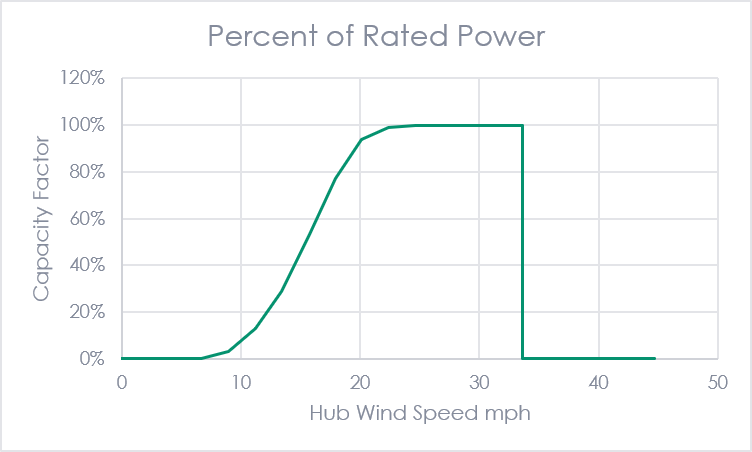
Using data for a 2 MW Vestas turbine, full power is achieved at a wind speed of around 11 meters per second (~25 mph). The rotor diameter is 110 meters. With these numbers, the available output from wind’s kinetic energy is around 5.8 MW, and therefore, the conversion efficiency from wind to electricity is – wait for it – 34%. Oh! And that’s the best efficiency it will achieve because output is capped at 2 MW even as available wind power increases per the capacity curve in Figure 1. At the cutout wind velocity of 33 mph, the turbine efficiency is only 10%. 😐 Did I mention the capacity factor of land-based wind turbines is only about 33%[2] of nameplate output?
Figure 1 Vestas 2 MW Capacity Curve
Modern solar panels convert solar energy to electricity at about 25% efficiency with a capacity factor of 21%.
All Types of Power Generation
By mixing engines and power generation of all types, I used Chat to compile them into Table 2.
Conclusion: the designers of solar PV just aren’t trying hard enough. No! Physics is a stubborn thing to move. All that solar energy is being wasted! Egad! If we converted it all to electricity, the planet would freeze solid, right? Well, I guess the mantle and core would still be hot.
Table 2 Power Generation Sources
Energy Converter | Useful Energy Output per Potential |
Human cyclist | 23% |
Gasoline automobile | 25% |
Solar PV panel | 25% |
Rankine steam plant | 33% |
Wind turbine (maximum operating point) | 34% |
Natural gas reciprocating engine | 45% |
Combined-cycle gas turbine | 63% |
Data Center Efficiency
Returning to the Fortune opinion piece, she says one-third of total energy consumed in a data center is wasted on non-computing work. It’s actually much worse than that because the non-computing work is mostly for cooling. Cooling what? Heat generated by the chips. Is heat the desired output of a computer chip? Of course not. When you pile that into the equation, the efficiency is probably closer to 2% of a solar ray or a cubic foot of natural gas converted into digital outcomes. I just made that number up, but I will come back to it to prove that it’s not unreasonable.
Computation is measured in rates called floating-point operations per second, adorably known as FLOPS. One measure of efficiency in terms of energy is FLOPS per Watt.
Let’s add it all up, or rather, chop it all down. Power is generated with 33% efficiency. One third of that is required to cool the computers (graphics processing units, or GPUs). The cooling equipment might be 500% efficient, which equals a coefficient of performance of 5.0, a SEER of about 18, or a kW/ton of about 0.7. About 3X the cooling energy is heat from the chips. So we have roughly 33% cubed of the source energy that produces something other than heat or heat removal. That is ~3.5% efficiency alone (back of the napkin), to say nothing of the value of the computations. As I noted in Picks, Shovels, and AI, companies of all sizes are struggling mightily to show any return on investment or improved productivity using AI models. So, not only does very little source energy convert to useful computation, but a tiny percentage, if any, benefits users.
Good Luck!
[1] GE Vernova, Gas Turbine Technology Overview (F-, H-, and HA-class turbine firing temperatures and cooling technology).
Siemens Energy, SGT-8000H Technical Description (turbine inlet temperatures around 1,500°C).
Boyce, M. P., Gas Turbine Engineering Handbook, 4th ed., Elsevier, 2012 (standard reference for compressor discharge and turbine inlet temperatures).
Walsh, P. P. and Fletcher, P., Gas Turbine Performance, 2nd ed., Blackwell Science, 2004.