

Powering AI Background
Last week, I described the advantages of data centers bringing their own behind-the-meter (BTM) power, which include speed to power delivery (of course, that’s what they want) and reduced risk of stranded assets that other rate payers would be paying for decades as the industry shakes out and only two or three powerhouses remain. Gee, that sounds like airlines, PC manufacturers, chip makers, and retailers. Another advantage I noted was reduced transmission and distribution costs, along with associated voltage-transformer costs.
Disadvantages of BTM generation include leaving the grid with a more variable demand to supply, and smearing costs over fewer kWh sold. That puts upward pressure on prices for remaining customers, including you. Data center developers would need to pay hefty fees for standby services and capacity reservations to “pay their fair share” (I normally hate that phrase). I wrote that ratemaking and regulation are critical to ensuring that data centers pay the actual cost of being served and to avoid shifting costs onto the commoners.
Realizing that data center developers are in it for number one, data centers, they suggested they bypass the lengthy interconnection queue in lieu of promising not to inject electricity onto the grid. Uh, no, Mx. Data Center. We do not trust you. Utilities agree. However, I concluded the post saying the regulated utility industry is immensely complex and that utilities and data centers, also known as large load customers, hold all the cards.
FERC Declares
Last week, as that edition of the Rant was going to press, the Federal Energy Regulatory Commission, FERC, declared that if not even the utilities, but the regional transmission organizations (RTOs) and Independent System Operators (ISOs) don’t get it right, FERC would intervene in an attempt to make it right.
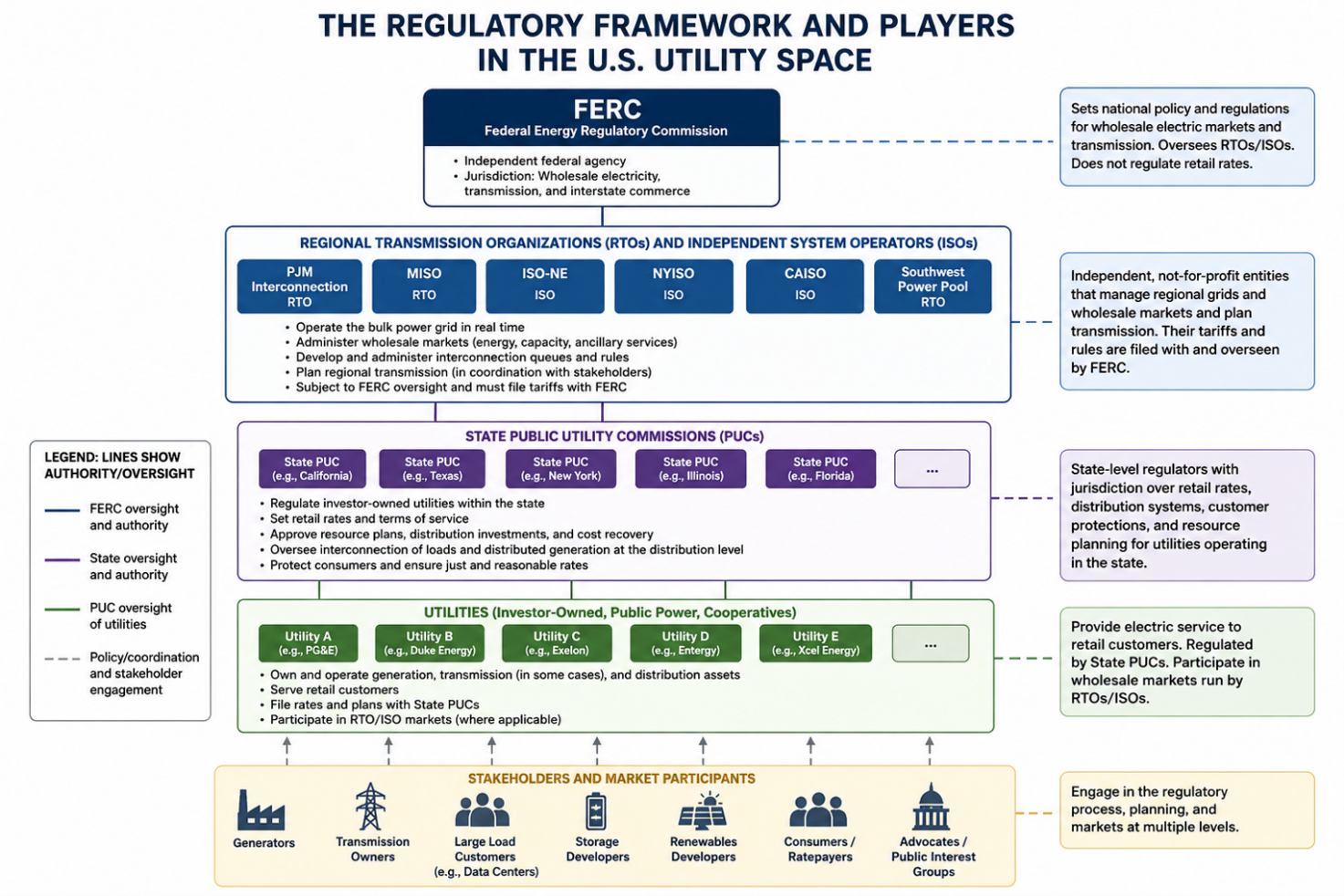
For reference, here is an AI-generated chart of the regulatory framework sitting on top of electric utilities.
Figure 1 Electric Utility Regulatory Compact
FERC suggested ways for RTOs and ISOs to entice and reward data centers that will curtail load, shift load, and rely on batteries and onsite generation to relieve grid stress to keep energy prices, namely, capacity charges, which are blended into flat or even time-of-use rates, for the little people. This sounds great on paper, but again, the utilities and data centers hold the cards. The question is not only whether you can reduce capacity, transmission, and distribution costs and risks, but also whether you will actively participate to keep costs low in the long term.
The problem with these kinds of load-flexibility scenarios is that many will not work for many, if not most, data centers because of service-level agreements with their customers. Customers pay for reliable service, and they don’t want it curtailed on Wednesday afternoon at 4:00 PM. As I wrote, it is immensely complex. Solutions would need to include no loss (curtailment) of service, which would only include backup generation and energy storage. Thermal energy storage, anyone?
I maintain that it’s like the carbon tax, which is the most effective way to reduce carbon emissions – but in that case, it hits the income-challenged the most. One benchmark is to keep electricity prices low enough that they do not exceed 6% of annual electricity costs or 10% of the combined natural gas and electricity charges for customers served by a single utility. The simple solution for data centers is to charge a risk premium, like 30%. Just do it! (won’t happen)
FERC Details
Utility Dive boiled the recent FERC “decision” down to six items:
- Take a regional approach – Rather than imposing one national rule, FERC directed each RTO and ISO to develop interconnection rules tailored to its own market and grid conditions.
- Stay in their lane – FERC did not intrude on state authority over retail electric service, customer choice, and siting decisions, limiting its actions to transmission jurisdiction.
- Protect ratepayers from cost shifts – FERC calls for greater transparency in network upgrade costs and for formal cost recovery agreements to ensure that large loads pay the costs they impose rather than shifting them to other customers.
- Provide options for flexible loads – FERC recognizes that data centers willing to curtail load, use batteries, or BTM generation during system stress may (should) be able to connect more quickly.
- Evaluate advanced transmission technologies – Before requiring costly new transmission, grid operators should consider alternatives such as advanced conductors, dynamic line ratings, power flow control devices, and synchronous condensers[1] that may increase capacity faster and at lower cost.
- Hurry up – RTOs and ISOs have a compressed schedule to respond to FERC’s show cause orders, and if they fail to develop adequate reforms, FERC signaled it is prepared to impose its own solutions.
In other words, FERC didn’t decide anything and told the RTOs and ISOs what I’ve already written about many times. On top of the RTOs and ISOs writing rules and so forth under FERC, there are state regulatory commissions, and under them, utilities.
Data center developers have the upper hand, for sure. Complex systems, like the world’s most complex system, our electric grid, with fragmented authority, rarely produce clear answers quickly. They do, however, create plenty of opportunities for well-capitalized, motivated developers to stay four steps ahead of the rulemakers. I’m sure they’ve hired armies of former FERC, state regulatory commission, RTO, ISO, and utility policy and ratemaking experts to end-run and outrun the bureaucracy.
Indeed, the bourgeois pitchfork brigade is the only institution, albeit unsanctioned and therefore uncontrollable, that can place a check on and slow the development of data centers and their insatiable appetite for natural resources, with water becoming the dominant resource. Ironically, this brigade will be the one fighting to protect their livelihoods and jobs.
To be continued, for sure!
[1] A synchronous condenser is like a flywheel, but can produce reactive power – a topic for another day.