
This week, we roll on to number eight on the top ten list of industrial efficiency measures: waste heat recovery. I already covered some waste-heat recovery technologies and approaches in process heating; specifically, boiler stack gas economizers.
Waste Heat Power Generation
I’ll start with the organic Rankine power cycle to convert high(er)-temperature, in this case, 500F and up, waste heat to electricity. An organic Rankine cycle (ORC) power plant uses the same thermodynamic cycle as a coal, nuclear, or bottoming cycle of a combined-cycle natural gas plant. While conventional power sources use water/steam as the working fluid, ORC plants use a refrigerant or hydrocarbon with a much lower boiling point than water, allowing the system to generate power from heat sources too cool for conventional steam generation.
The Gap Between Ideal and Real Efficiency
In the early days of our first semester of thermodynamics, we learned that the simplest formula for efficiency is the Carnot Cycle. This ideal or reversible engine provides a theoretical maximum efficiency. The formula (pun alert) boils down as follows:

Where:
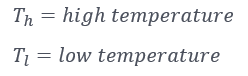
Temperatures are absolute, in this case degrees Rankine (R), which is degrees Fahrenheit (F) plus 460.
Doing head math, you can see that as the high temperature increases, efficiency increases as the second term/fraction shrinks with higher Th. With a high steam temperature of 1,100F and a low condensing temperature of 100F, the ideal Carnot efficiency is about 64% while the actual plant efficiency is around 35%. Using a waste heat source temperature of 700F, the ideal Carnot efficiency of an ORC plant would be about 47%, with an actual “real-world” (I love that term 🙄) efficiency of about 15%. Nevertheless, the heat is free. Years ago, I analyzed the production potential of a glass plant that could achieve 2 MW of continuous power from its 700F exhaust. The capital cost to capture the waste heat, of course, is high.
One last thing on ideal/maximum and real energy efficiency: a combined-cycle natural gas plant (see Figure 1, courtesy of Bridgestone Associates, Ltd.) with a gas turbine (Brayton) on the topping cycle, and a Rankine steam-turbine bottoming cycle, has a high temperature of about 3,000F.
Summing up all these ideal and real efficiencies in one spot, I present Table 1.
Figure 1 Combined Cycle Power Plant
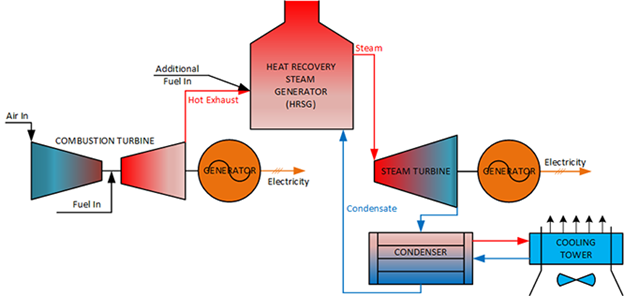
Table 1: Ideal and Real Power Cycle Efficiencies
Combined Cycle Natural Gas | Coal/Nuclear | Organic Rankine Waste Heat | |||
Degrees F | Degrees R | Degrees F | Degrees R | Degrees F | Degrees R |
3,000 | 3,460 | 1,100 | 1,560 | 600 | 1,060 |
100 | 560 | 100 | 560 | 100 | 560 |
Carnot Efficiency | 84% | Carnot Efficiency | 64% | Carnot Efficiency | 47% |
Actual Efficiency | 65% | Actual Efficiency | 35% | Actual Efficiency | 15% |
The bottom line for waste heat power generation is:
- The volume of heat needs to be huge
- The temperature needs to be high – at least 700F. Industries include steel, foundries, glass, cement, aluminum, and petrochemicals.
- The heat availability and power demand must be at 100% of plant capacity for as many hours as possible – 8,000 plus per year.
Data Center Heat Waste
At the opposite end of the waste-heat opportunity spectrum, we have data centers that churn out hundreds of megawatts of thermal energy per site. However, the temperatures are so low that they are nearly useless. Sure, they can be used for space heating, but even with that, the maximum potential temperature is roughly 120F. That was my guess. I queried Chat, and it replied, “Data center waste heat is usually low-grade heat, often around 80–120°F for conventional systems, and perhaps 100–140°F with liquid cooling – useful for preheating or heat pumps, but nowhere near the temperature needed for most industrial process heating.”
But aside from heating even industrial processes, it’s not hot enough for even space heating/HVAC loads. Boosting the temperature adds complexity, first cost, and operating costs (energy and maintenance).
Compressed Air: A Low-Grade Heat Source
Air compressors are essentially electric heaters because ~90% of the electrical energy consumed is converted to heat. However, like data centers, the temperature is quite low for heat recovery – around 200F. Also, while compressors consume roughly 10% of industrial sector electricity (a lot), that is somewhat of a drop in the bucket. If they can be water-cooled, they could be a good source for preheating makeup water. However, there are probably a dozen better waste heat streams for that load as well. While I wouldn’t rule out air-compressor heat recovery, I’d consider other sources of heat.
What Makes Waste Heat Recovery Actually Work
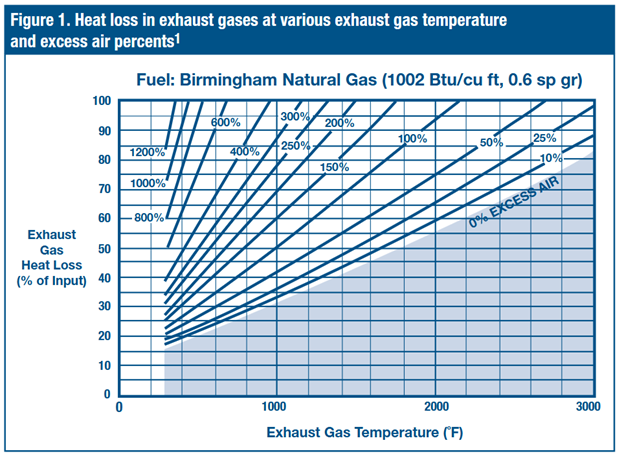
Wrapping up waste-heat recovery, I stumbled onto this useful chart from the DOE. It demonstrates why high exhaust temperatures waste excessive amounts of heat, namely, heated nitrogen from ambient air, but also how little useful energy there is in lower temperatures. For example, at 700F, which I discussed above, “only” about 20% of the source heat is wasted.
Another trait of successful industrial heat recovery is that the waste stream should be free of contaminants, especially goo and fuzz. Examples include heat recovery from fryers, dryers, food processing ovens, and industrial-scale laundries. Those contaminants will collect on heat-exchanger surfaces, degrading their performance at best and, at worst, requiring a process shutdown for cleaning. I’ve analyzed numerous opportunities over my career and had to throw in the towel on what seemed like a simple application. The only workable solutions are those designed for specific use cases. Trial and error is strongly discouraged.
Chat tells me the following are good applications for heat recovery, even though the waste streams can be nasty. Heat exchangers are designed to be fairly crude (less effective) in exchange for easier maintenance, cleaning, and uptime.
- Spray dryers in dairy processing — powdered milk and whey plants recover heat from dryer exhaust using washable heat exchangers, run-around loops, and clean-in-place systems despite severe fouling potential.
- Industrial laundries — large laundries recover heat from dryer exhaust, wastewater, and boiler blowdown using filtration and fouling-resistant heat exchangers.
- Potato processing and fryers — snack food manufacturers recover heat from fryer and oven exhaust for makeup air and process water heating using indirect heat exchangers and filtration systems.
- Bakery ovens — commercial bakeries recover heat from greasy oven exhaust streams using heat pipes, run-around coils, and automated washdown systems.
- Wood products and biomass dryers — lumber kilns and biomass drying systems recover heat from particulate- and pitch-laden exhaust streams using cyclones, economizers, and rugged exchanger designs.
- Rendering plants [mmm, rendering plants!]— protein and rendering facilities recover heat from extremely dirty exhaust streams using shell-and-tube exchangers and continuous cleaning systems.
- Pulp and paper mills — mills recover heat from black liquor evaporators, hood exhaust systems, condensates, and multiple cascading process streams throughout the facility.
- Wastewater treatment plants — facilities recover heat from sludge drying, digester systems, and wastewater effluent using heat pumps and fouling-resistant heat exchangers.
Happy heating! Next week, we roll on with industrial heat pumps and thermal integration.