Moving on with our top ten list of industrial energy efficiency and load management categories, this week we are tackling process heating – #7 on the list. Note that these are ranked by typical adoption, with the most sophisticated operators deep into this list. They are not ranked by impact. The list might be upside down for that.
- Lighting upgrades (LEDs, controls)
- HVAC optimization (high-efficiency units, economizers, controls)
- High-efficiency electric motors
- Variable frequency drives (VFDs)
- Compressed air system optimization (leak repair, pressure reduction, controls)
- Pumping and fan system optimization (right-sizing, system redesign)
- Process heat improvements (high-efficiency burners, furnaces, insulation)
- Waste heat recovery systems (recuperators, heat exchangers, ORC systems)
- Industrial heat pumps / thermal integration
- Advanced process controls and real-time optimization (automation, digital twins, AI)
I’ll jump to the conclusion first and explain the details at the end of this heating series. The conclusion is that electricity is efficient and effective for process heating at low temperatures, up to maybe 150F. Electricity is also efficient and effective for heating to very high temperatures, like over 2000F, for applications like steel processing, e.g., rolling. Natural gas is the fuel of choice from about 150F to at least 1000F.
Heat Pumps and Their Limitations
For low-temperature heating, processes, hot water, or space heating, electric heat pumps are a fine choice. However, they have diminishing efficiency at end-point temperatures above ~150F. The limitation is due to temperature lift, which is the difference between the heat source (cooler/cold) and the desired output temperature (hot).
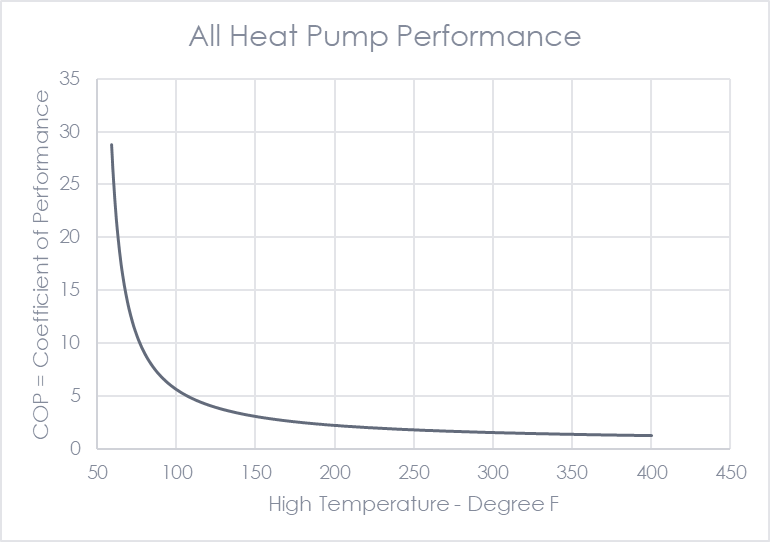
At modest lifts, like heating water to 100–140°F, heat pumps can deliver three to five units of heat for every unit of electricity consumed. The units of heat delivered divided by the units of electrical energy consumed is the coefficient of performance, or COP. I covered this two years ago, and I am replotting the typical performance in Figure 1.
Figure 1 COP Versus Heat Pump Temperature Produced
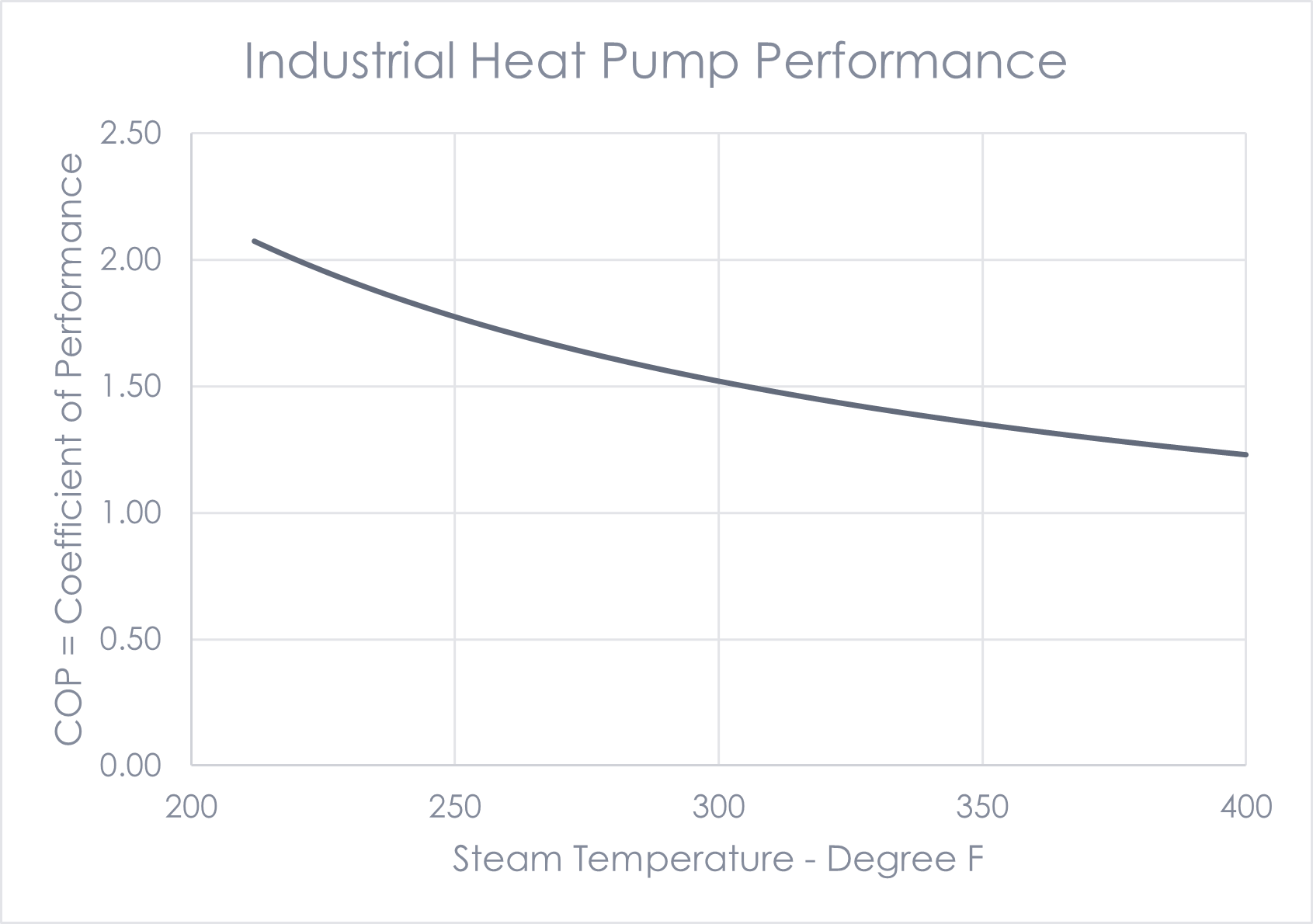
At higher temperatures, the coefficient of performance (COP) collapses. The compressor ends up doing so much work that the system begins to resemble electric resistance heating, where one unit of electricity produces roughly one unit of heat. This is evident in Figure 2 as temperatures approach 400F, in theory.
Figure 2 Heat Pump COP at Higher Temperatures
I’ll end this section with a quote from an engineer in the energy efficiency world of a large, electric-only utility that is our client. He said industrial heat pumps, presumably high temperature, make no sense, and they never will. It’s the physics of the refrigerant and phase change characteristics.
Natural Gas
Heat pumps are great at heating temperatures below 150F. From there up to 1,000F, natural gas is the fuel of choice for both cost and GHG emissions. Here, I explain “efficiency” in terms of heat delivered per dollar of fuel or per unit of greenhouse gas (GHG) emissions.
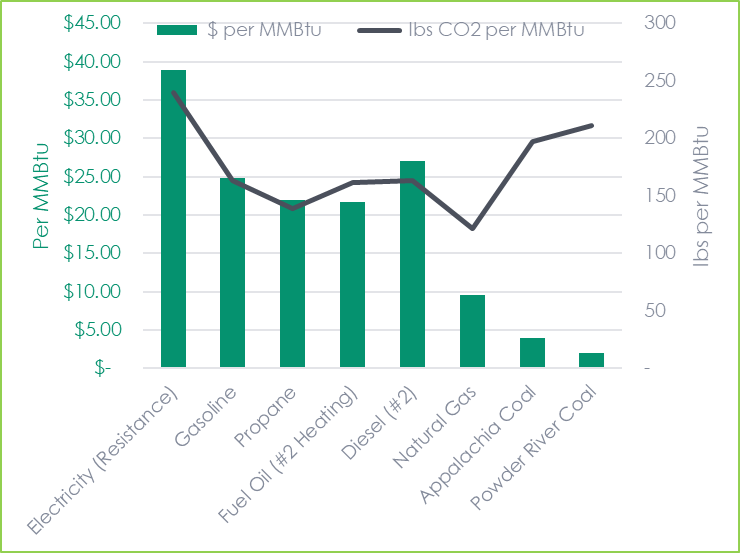
Figure 3 shows fuel cost and GHG emissions per million BTU of heat delivered by a range of fossil fuels and electricity, using a resistance coil such as in your toaster, oven, hair dryer, curler, or space heater. The emission numbers are based on the average carbon content of electricity across all 50 states, and local/regional fuel costs as of the fall of 2025.
Heat pumps produce less GHGs per unit of heat output than natural gas, but natural gas is a lower-cost fuel, especially as electricity prices are outpacing general inflation. Read anything about soaring electricity prices lately, Peppy?
Figure 3 Heating Cost by Fuel Type
One characteristic that heating with natural gas and heat pumps have in common is that they both get less efficient as the output temperature rises. For heat pumps, this is evident in Figures 1 and 2. When the temperature of air, water, or steam produced increases, the flue or exhaust gas temperature increases, all else equal. Hotter exhaust gas carries more heat, which is waste. I could bore readers with stoichiometry after wasting lots of time learning it again, but take my word for it. Every 40F increase in exhaust temperature reduces combustion efficiency by one percentage point. E.g., a boiler making 500F steam rather than 400F steam is about 2.5 percentage points less efficient, all else equal. Therefore, like compressed air, energy managers should only produce what is required (temperature) for the load. Dedicated high-temperature/pressure boilers may be warranted for these loads, just as dedicated high-pressure compressors may make sense for certain loads.
Combustion Efficiency
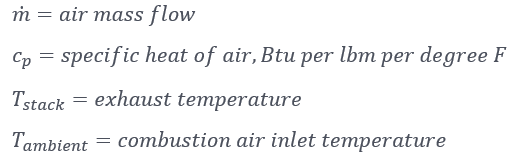
One way to reduce exhaust or stack temperature is to use excessive air for combustion, but this is a bad choice. Stack losses are demonstrated in Equation 1. As the air mass flow increases with excess air, the losses increase and efficiency drops.
Equation 1 Boiler Stack Losses

Where:
To maximize combustion efficiency, minimize excess air. What does that mean? We only need enough air to oxidize (burn) the fuel, so we don’t want a lot of oxygen in the flue gas. More importantly, air is about 79% nitrogen, which goes along for the ride, carrying heat produced by natural gas[1] with it. Insufficient air is bad for two reasons: first, it results in carbon monoxide; second, some fuel may pass straight through the burner and out the stack.
Controls monitor stack gases, particularly oxygen and carbon dioxide, to keep excess air to a minimum and efficiency at a maximum. The control system precisely matches combustion air volume/mass flow to match fuel flow for all conditions.
Heat Recovery
Industrial boilers are designed to be non-condensing. What? Burning natural gas produces two parts water and one part carbon dioxide, per the ninth-grade chemical reaction shown in Equation 2. When the exhaust gases are sufficiently cooled, water will condense, which explains why automobiles spit liquid water out of the tailpipe during the first few miles of winter driving.
Equation 2 Natural Gas Combustion

Off-the-shelf or out-of-the-warehouse boilers are not designed to reduce flue gas temperatures to the condensing range.
I just described in the previous section that a way to improve boiler efficiency is to reduce Tstack. The way to do that is with an external heat recovery heat exchanger, aka “economizer,” to suck more heat out of the exhaust and down into the condensing range. A cartoon of a system like this is shown in Figure 4.
Figure 4 Boiler Stack Gas Economizer
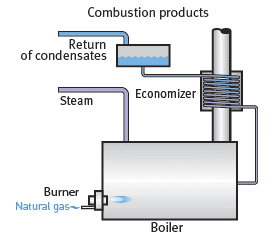
The system depicted in Figure 4 uses “condensates,” which is the condensed steam, not to be confused with exhaust condensate. But like a pot of boiling water that just lost its source of heat, the condensate is hot, like 180F. To suck even more heat out of the flue gas, use colder makeup water where possible. Needs include boiler blowdown, service hot water for cleaning and washing, etc.
This is a good example of capturing exergy, which I introduced nine years ago in Exergy, Easy. Read up, as it especially applies to industrial customers, and a good example is posted in this section on heat recovery and economizers.
Next Up
Next week, I will polish off steam, discuss high-temperature applications of industrial heating, and wrap up with memorable conclusions.
[1] Or whatever the fuel is: fuel oil, propane, kerosene, wood chips, refuse, etc.