After taking a detour from industrial efficiency in posts one and two to evaluate electricity prices and the blame game hung around data centers like the scarlet letter, we’re moving on to the top ten list of industrial energy efficiency targets. For reference, the list is provided in Table 1. Numbers 1-4 have been covered in posts one and two. This week, I will knock off part of #5, compressed air – a huge topic.
Table 1 Top Ten List of Industrial Efficiency Targets
- Lighting upgrades (LEDs, controls)
- HVAC optimization (high-efficiency units, economizers, controls)
- High-efficiency electric motors
- Variable frequency drives (VFDs)
- Compressed air system optimization (leak repair, pressure reduction, controls)
- Pumping and fan system optimization (right-sizing, system redesign)
- Process heat improvements (high-efficiency burners, furnaces, insulation)
- Waste heat recovery systems (recuperators, heat exchangers, ORC systems)
- Industrial heat pumps / thermal integration
- Advanced process controls and real-time optimization (automation, digital twins, AI)
Compressor Types
There are three major types of air compressors serving the industrial sector:
- Centrifugal (dynamic)
- Reciprocating (positive displacement)
- Screw (positive displacement)
What type is most efficient? The proper engineer’s response to that question is, “It depends.” Full-load efficiency is one thing, but, as with everything else in the efficiency world, part-load efficiency matters more. Even during peak load, a compressed air plant will not run all compressors at full load. There must always be reserve capacity (trim), not unlike the power grid.
Table 2 provides a range of air compressor efficiencies for 100 PSIG (pounds per square inch gauge), the most common nominal performance metric, for the compressor types noted above. It provides relative full-load efficiency in brake horsepower (BHP) per 100 cubic feet per minute (CFM) and efficiency characteristics when running at less than full capacity.
Table 2 Air Compressor Efficiency Characteristics
Compressor Type | Full Load (BHP/100 CFM) | Part Load Efficiency | Optimal Priority | Notes |
Centrifugal | 16-20 | Poor | Lead | Best efficiency at full load; sharp drop-off when unloaded |
Rotary Screw (oil-flooded) | 18-22 | Moderate | Lead | Good turndown with VSD; common industial workhorse |
Reciprocating | 20-25 | Stepwise | Lag | Efficient at full load; losses with unloading |
Rotary Screw (VSD) | 18-24 | Good | Lag | Slightly worse peak efficiency, better system efficiency |
More specifically, part-load efficiencies are depicted in Figures 1, 2, and 3 for these types of air compressors.
Figure 1 Part Load Rotary Screw Air Compressor Efficiency
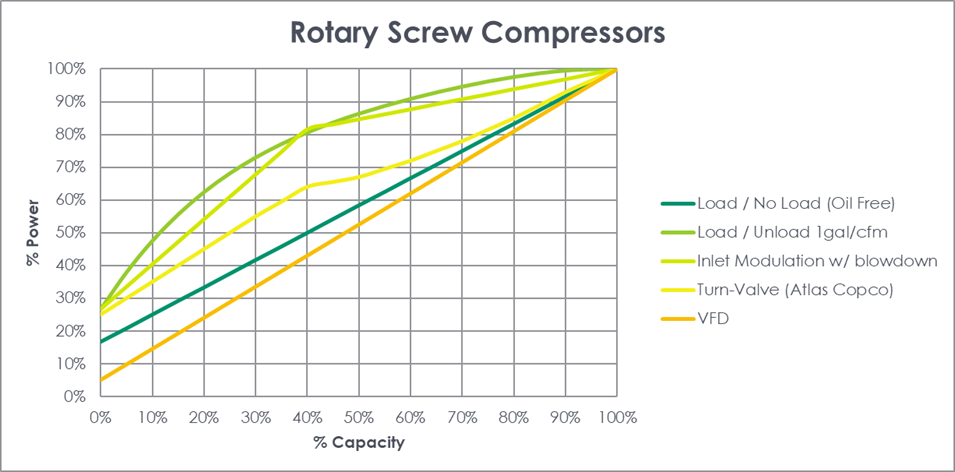
Figure 2 Part Load Reciprocating Air Compressor Efficiency
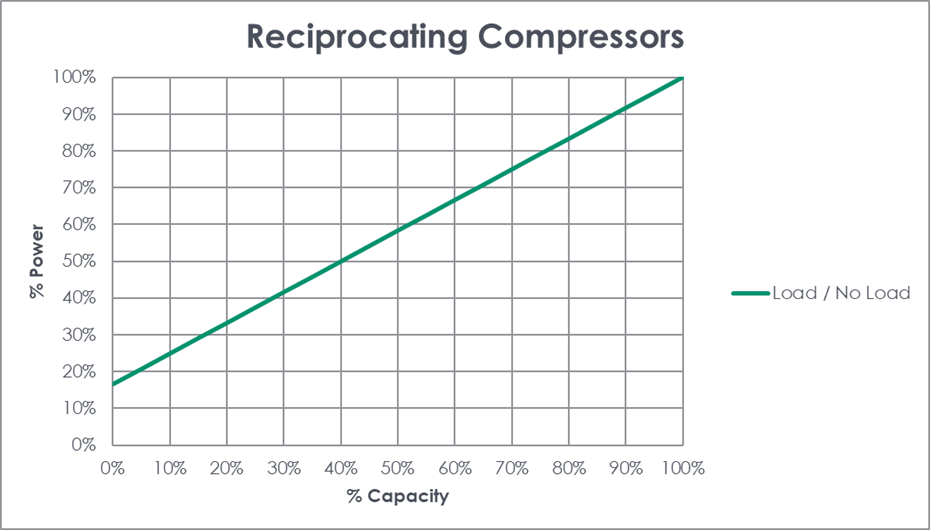
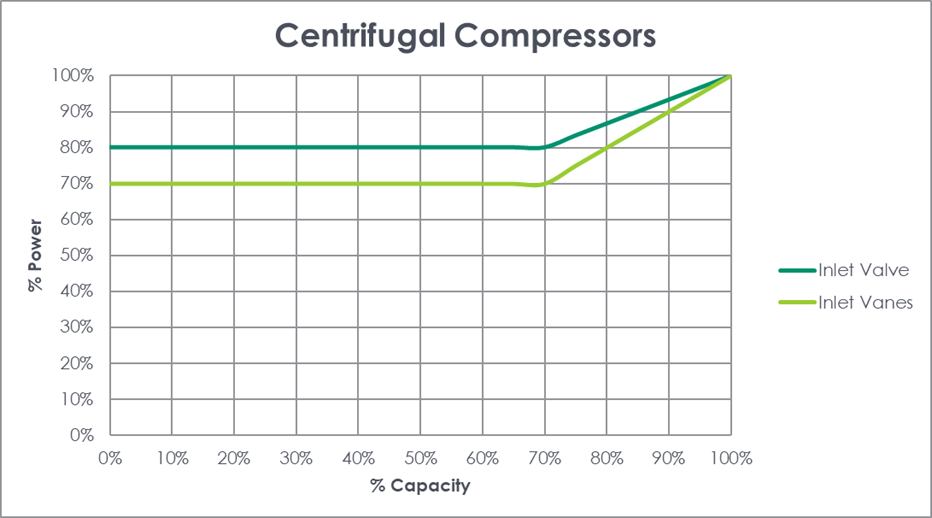
Figure 3 Part Load Centrifugal Air Compressor Efficiency
Rotary Screw Compressors
Rotary screw compressors dominate the modern market share for industrial applications due to their reliability and ability to operate continuously under varying loads. Among rotary screw compressors, there are two types: lubricated and oil (or lubricant) free.
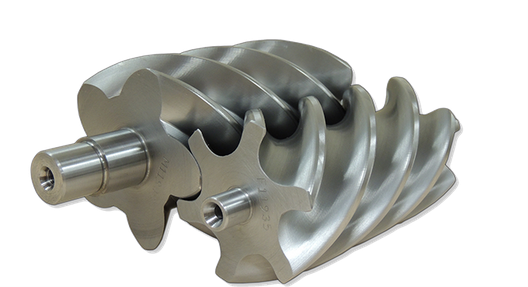
Lubricant is used between the meshing screws in Figure 4, courtesy of VMAC, to cool, seal, and, uh, let’s see, lubricate the meshing rotors. Lubricated compressors are by far the most common. They are also more efficient than lubricant-free designs, as there is less leakage or air slippage between the rotors. Oil-free compressors are used when air purity and the absence of aerosol lubricant are required, such as in food or pharmaceutical manufacturing.
Figure 4 Rotary Screws
Rotary screw capacity is modulated in several ways, including inlet valves (throttling), rotor shortening (turn valve), load/unload, and variable frequency drive.
Since inlet valves and throttling devices generate excessive entropy, they are among the least efficient ways to control compressed air flow at constant pressure.
Rotor shortening and turn-valve control modulate capacity in rotary screw compressors by bypassing or shortening the effective compression path, allowing some of the air to recirculate instead of being fully compressed and discharged. Recirculating, like throttling, wastes energy and generates entropy. Turn-valve control on a rotary screw compressor can typically reduce capacity to about 40% to 50% of rated flow, after which the machine usually must fall back on inlet modulation and load/unload control because stable, efficient turndown is exhausted.
We can see in Figure 1 how these efficiencies vary. Lubricant-free compressors can be loaded and unloaded repeatedly with no implications. An unloaded compressor has the inlet port closed, so there is no mass (air) flow. The discharge is opened to atmosphere. The power doesn’t drop to zero, but rather to something closer to 25%, as shown.
Lubricated compressors cannot be cycled continuously between load and unload because air pressure is used to move the oil. If pressure is cycled excessively in magnitude and frequency, oil separation from the air and its circulation through the unit become problematic. Equipment damage may occur, and air quality/cleanliness will be impacted. Therefore, pressure must be reduced gradually, and as it is reduced, compressed air is released to the atmosphere, generating more entropy.
Compressed air storage can be used to reduce the need for cycling between load and unload, and to smooth out pressure fluctuations in the system. Reduced cycling improves efficiency, but the other major benefit storage provides is that it reduces the likelihood of pressure increases when consumption increases faster than production. I will cover more storage details in future posts.
Rotary-screw air compressors are a great match for variable-frequency drives (VFDs), and vice versa. In Figure 1, we see that the VFD option has the lowest percent of nameplate power per percent of capacity. I.e., they are efficient at part load. These machines should always be used for “trim,” or the final bit of airflow delivered to the system.
Centrifugal Compressors
As indicated in Table 2, centrifugal compressors are the most efficient of the big three compressor types, but only at full load. They have awful, aka, “poor” unloading characteristics. The reason is a phenomenon known as surge, or a momentary reversal of flow. Centrifugal compressors use a high-speed impeller (e.g., 10,000 revolutions per minute) to generate kinetic energy with air, which is converted to pressure in the diffuser via the Bernoulli principle. The velocity at any speed and pressure is simply a vector calculation. I remember this from turbomachinery class.
The impeller can only be starved of air to a certain degree via an inlet valve or vanes, until the pressure created results in a reversal in portions of the impeller, at which point vibration can damage the machine. To avoid flow reversal, surge, and compressor damage, compressed air is relieved to the atmosphere, resulting in horrendous entropy generation and hemorrhaged energy. Therefore, centrifugal compressors are great for baseload, 100% of nameplate airflow capacity. Nothing else.
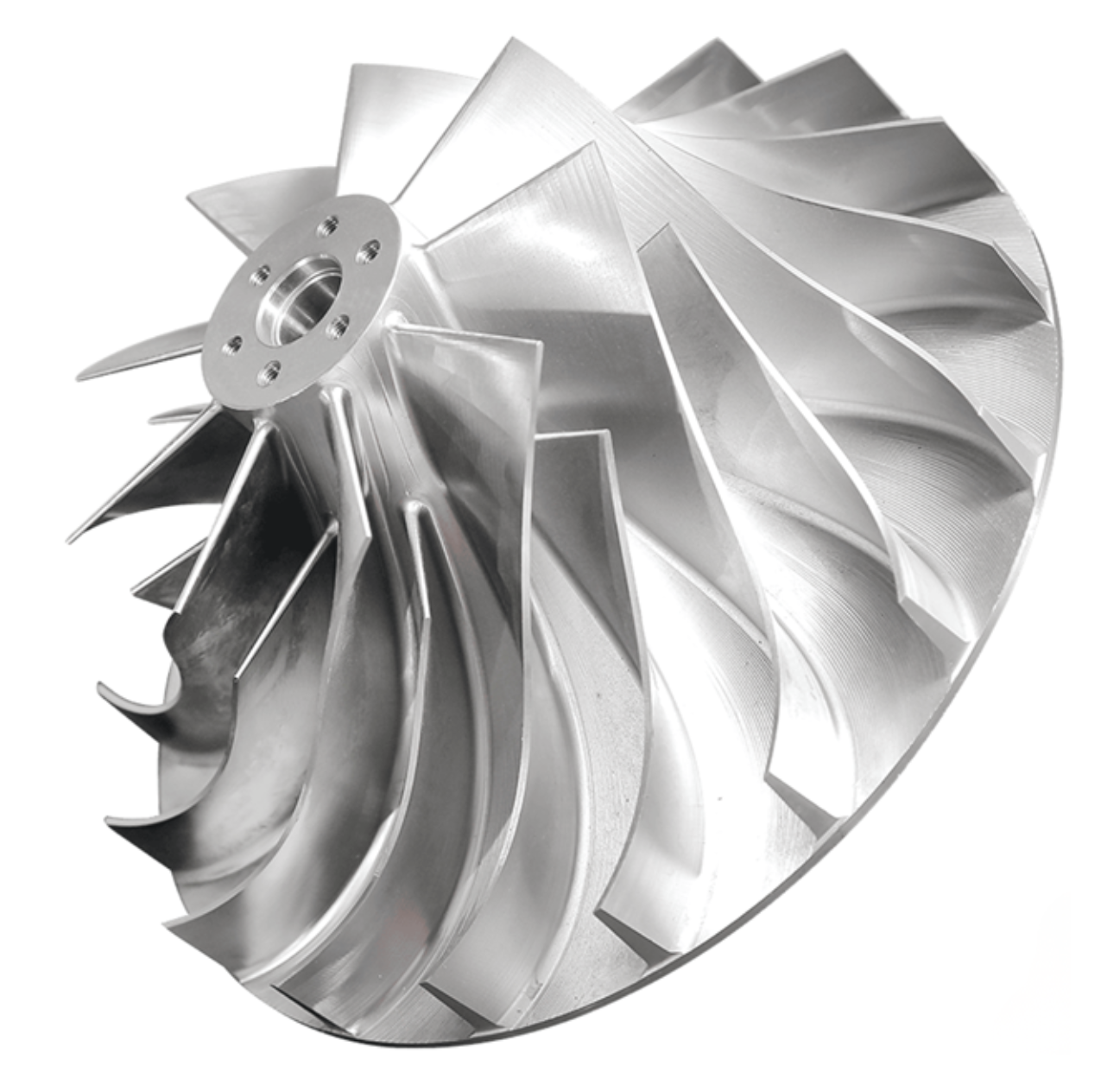
Kaishan provides a nice image of a centrifugal compressor impeller in Figure 5 and a representative video of it in action, complete with inlet vanes. Dig it.
Figure 5 Centrifugal Compressor Impeller
Reciprocating Compressors
Reciprocating compressors (recips) are the oldest of the three technologies, and like many other technologies, they have been replaced by simpler, lower-maintenance-cost machines. Centrifugal compressors have one moving part – the rotor with attached compressor(s). Centrifugal compressors may have two or three moving parts, depending on the number of stages and intercooling, as shown in the Kaishan video.
Screw compressors have two primary moving parts, the meshing rotors (see Figure 4).
Reciprocating compressors, an extension of the steam engine, include moving pistons, crankshaft, and valves. Recips perform well in terms of efficiency, both at full load BHP/100 cfm and at part load, as shown in Figure 2. They perform well at part load because they simply unload the cylinders, allowing the pistons to eject air to the atmosphere in an open cycle.
Reciprocating compressors are like old boilers – they last as long as they are maintained. These machines are still for sale today for smaller applications (automotive shops), high-pressure applications, and refrigeration systems.
Closing Remarks
In the world of air compressors, choose large-capacity types such as centrifugal and oil-flooded screw compressors, which are ideal for baseload supply at 100% of nameplate airflow. Do not use these types, especially centrifugal compressors, for trimming to the last cfm required by the compressed air plant.
Choose lubricated screw compressors with VFD speed control to trim to the last cfm required by the plant. A second alternative for trim is a reciprocating compressor.
Next week, I will dive into other aspects of compressed air plants and systems.