This Energy Rant examines the retraction of a high-profile climate economics study from Germany’s Potsdam Institute, which projected catastrophic global economic losses by mid-century. The episode illustrates how implausible modeling assumptions, confirmation bias in peer review, and exaggerated claims can undermine scientific credibility, distort policy decisions, and weaken public support for climate action rather than strengthen it.
When Climate Damage Forecasts Exceed Economic Reality
The Wall Street Journal provided catnip to editorial page readers (although I stayed out of this one) with its Op-ed, A Climate Study Retraction for the Ages. The retraction was of an article in Nature, which had given an apocalyptic forecast of the end of the earth by 2049. This sounded like the fourth one-eighty in fifty years.
The Journal summarizes the crux as follows: “Scientists at Germany’s Potsdam Institute for Climate Impact Research projected that climate change could cause $38 trillion in economic damage a year [my emphasis] by 2049. To put that number in perspective, the GDP of North America last year was about $31.4 trillion.”
Why Plausability Bookends Matter in Risk Modeling
There is a perfect example, as I explained a few weeks ago, that AI data centers would require 1,000 GW of capacity by 2030. The maximum load is around 780 GW today. I wrote, “There is no way to power that load, that fast.” Relax.
Somebody with a similar mindset should have critiqued the hyperbolic Potsdam Institute climate model projection. I call it putting things in perspective with bookends. Risk assessments use bookends like “what’s the worst thing that could happen?” In this case, I would ask, really? The GDP of North America every year?
How Confirmation Bias Slips Through Peer Review
This is how credibility is lost. The pander-free Energy Rant provides a check on the efficiency, load management, renewable energy, decarbonization, and electrification rages. I’m here to help by being a critic to protect against Potsdam-levels of absurd assertions.
Reading further into the Journal article, the amusing thing is that the needle that broke the camel’s back was bogus data on Uzbekistan. Apparently, Uzbekistan isn’t big enough to bury a dead body. Somebody noted the stench. “Post-publication, the results were found to be sensitive to the removal of one country, Uzbekistan, where inaccuracies were noted in the underlying economic data for the period 1995–1999,” the climate study retraction says.
Why wasn’t this caught earlier? The Journal suggests confirmation bias in the peer review. Their livelihoods are supported by the same cause and pseudo-science.
When Central Banks Treat Bad Models as Stress Tests
Apparently, a group of central banks, known as the Network for Greening the Financial System, factored the findings of the bogus study into its climate stress test scenarios. Is this why interest rates shot up in recent years? Maybe not, as rates had already hit their five-year peak about a year before the study was released. Nevertheless, Jerome Powell pulled the Federal Reserve out of the racket.
Alarmism and the Collapse of Public Trust
The Journal article suggests these sorts of cries, “wolf, wolf,” are the reason Americans don’t believe claims of the climate apocalypse (especially when originators shun nuclear power, I would add). The claims are unbelievable.
I recall Harry Enten from CNN last summer going apoplectic over the naivete of the American people, “despite ooowl of these horrible weather events,” which are magnified and looped endlessly on CNN. Caution: Consume the video in small doses until your tolerance has been established.
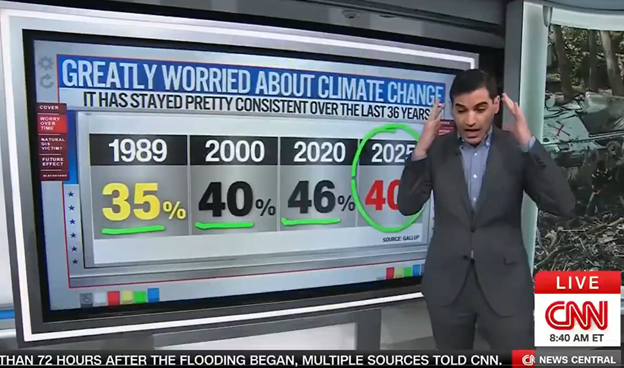
“Americans aren’t afraid of climate change,” Enten concluded. “Climate activists have not successfully made the case to the American people.” No, Harry. It’s because of hucksters like those at the Potsdam Institute and the limits of climate modeling.
“In the summer of 2024, for example, when record high temperatures brutalized outdoor workers, withered crops, and worsened hurricanes, only 12% of US national TV news segments mentioned climate change, though its role in driving such extreme heat has long been scientifically indisputable.”
The summer of 2024 was brutal, but as a lifetime Phoenician Lyft driver drove me to Sky Harbor, he informed me that 2025 was unusually cool and the fall had showered them with record rain. The landscape was unusually green for late October—likewise, no wildfires in California this fall or winter. To burn an old cliché, the only constant is change.
Why Cost, Not Fear, Drives Successful Decarbonization
The Wall Street Journal’s article, Europe’s Green Energy Rush Slashed Emissions—and Crippled the Economy, the foundation of last week’s Rant is quoted, “The shift is also adding to a cost-of-living shock for consumers that is fueling support for antiestablishment parties, which portray the green transition as an elite project that harms workers, most consumers and regions.” This is a significant factor for the commoners who can smell a scam from the other side of the planet.
Unlike the weather, some things never change. What never changes is people’s desire to keep more of their money and get more bang from what’s left. To bring everything along, there needs to be financial and other benefits; otherwise, cost-effective decarbonization is going nowhere.
Table 1 Rant Posts on Cost-Effective Decarbonization
Rant/Post Title | Quote (affordability / profitability theme) | Link |
Rant Revelations Unleashed | “Profit rules. Decarbonization can only happen if it is profitable. That is how we decarbonized to current levels.” | |
Pants on Fire Fact Pickers | “Decarbonization will continue if it costs less than conventional sources.” | |
Nuclear Power Over White Rabbits for a Reliable, Affordable, Zero-Carbon Future | Emphasizes that zero-carbon power must also be reliable and affordable or electrification fails at scale. | |
Electrification Gangsters | Critiques electrification schemes that drive costs up, implicitly arguing electrification only works when it makes economic sense. | |
Electrification — Damn the Torpedo | Warns that forcing electrification without regard to system cost, grid upgrades, or economics is reckless. | |
Energy Rant social post (cost-effective decarbonization) | “Jeff is ranting about how to cost-effectively decarbonize the grid…” |
Succinctly, every successful decarbonization trend penciled to decrease cost or improve productivity. Every failed movement didn’t. Enduring infrastructure transitions and movements follow margins and improve lives.