
I was planning to write about toothpaste this week. Instead, data centers hijacked my inbox—and the headlines. Opposition to data centers is accelerating fast enough that one of my six-pack predictions came true almost immediately: they’re becoming as politically toxic as coal plants once were. But blaming data centers for rising electricity prices and grid stress misses the point. The real culprit isn’t demand growth—it’s a power market that no longer respects physics, reliability, or accountability.
Fracking Bans and Data Centers
Last week, Peter Huntsman wrote a guest editorial in The Wall Street Journal, They’re Coming for Our Data Centers. Instead of coal, he compared the movement to fracking bans. Fair enough.
Mr. Huntsman opens by writing, “Environmental nonprofits[1] are deploying the same playbook against data centers that they have used against oil, gas, nuclear and chemical companies over the past decade, and many business leaders are again tempted to stay silent.” However, I would add out of the gate that I think resistance to data centers cuts across all political persuasions. Their voracious appetite for water and perceived pressure on electricity prices are universal pressure points.
Huntsman notes that coal plants have shut down faster than they can be replaced, and pipelines have been blocked. Coal plants shut down for one overarching reason with several sub-reasons. The overriding reason is that they are too expensive to operate in the confines of current policy and electricity markets.
Cheaper Generation, More Expensive Electricity
Last August, I wrote that there seems to be a reversal of the second law of thermodynamics, because the cost of electricity generation via renewables is plummeting while electricity prices are soaring. How can that happen?
I hypothesize that electricity markets are broken and do not work. They reward come-and-go bits and pieces here and there while losing sight of the whole. Faulty power markets and market manipulation feature two examples.
In October, Utility Dive reported that “Grid planners and experts on why markets keep choosing renewables.” That article notes, “intermittent resources can be reliably scheduled and called upon using sophisticated software and other tools.”
Did someone say second-law reverser or maybe physics violator? I’ll come back to that.
“They also point to both the [bogus] levelized cost of electricity for renewables and their competitiveness in automated energy markets that select the least cost units to run in each hour.” There you are. We just need to automate the grid, maybe with AI powered by diesel generators, to bridge the dunkelflautes.
Bueller?
In a Rant first, I quote Ferris Bueller, “Life moves pretty fast. If you don’t stop and look around once in a while, you could miss it.” By that I mean, some things are in plain sight, but they don’t jump up and bite you in the buttocks.
Marty Kushler, former ACEEE senior fellow, recently penned this Viewpoint: The plan to build new data centers will destroy Michigan’s climate plan. He writes that a single “server farm” might draw 100 megawatts (MW) of electricity demand. That’s close, but newer data centers pack north of 200 MW under one roof. Mr. Kushler notes that two of the modest “data farms,” or one hyperscale data center, use the equivalent of all Michigan’s energy efficiency program savings, about 1.73 billion kWh, in 2024. He noted, “Worse yet, the massive new 1.4 Gigawatt (GW) data center proposed by DTE is 14 times larger, and would essentially require enough new electricity generation to wipe out seven times those total annual savings!”
First, I don’t understand this line of thinking at all.
- Greenhouse gases don’t stop at the state border. If these data centers aren’t built in Michigan, Indiana or Ohio, coal-rich states with practically no energy efficiency spending, would welcome them with open arms.
- If I were concerned about climate change, I would want data centers built in states with strong efficiency programs, like Michigan, which Kushler says ranks among the top five nationwide, rather than, say, North Dakota.
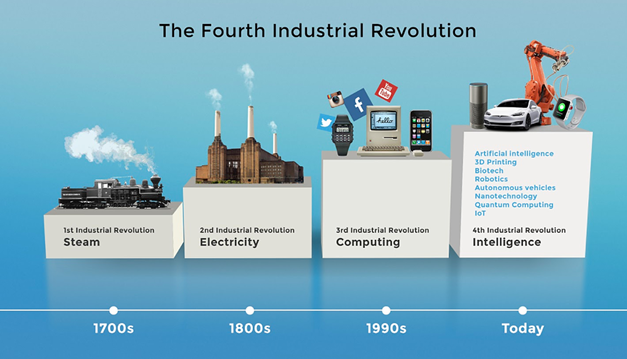
Second is what he doesn’t mention but is implied. There is no mention of what will power these data centers. Marty is a smart guy, and his silence on the matter suggests he doesn’t believe carbon-free electricity from renewables is a scalable, reliable, low-cost source of power for the Fourth Industrial Revolution.
Figure 1 Industrial Revolution 4.0
Data Centers in the Next Industrial Revolution
Mr. Huntsman writes, “Data centers aren’t a luxury. They are the factories of the 21st-century economy, converting energy into processing capacity [Industry 4.0], the way refineries convert oil into gasoline and chemical plants convert minerals into batteries [Industry 2.0].”
And pay special attention to this part, “Treating them as something society can simply pause doesn’t reduce demand for digital services; it constrains the supply of compute, raising costs and outsourcing technological progress elsewhere [like Ohio or Indiana].
Finally, Huntsman writes,” Too many CEOs failed to challenge energy policies they knew were unworkable.” Not me, baby. And, “Some supported them outright, either because they misunderstood physics or because political pressure made dissent risky.” Not me, baby!
Conclusion
There are too many cooks in the kitchen. The electricity markets don’t work to deliver reliable, inexpensive electricity over the long haul, especially in an environment of 4.8% compounded annual load growth like the PJM region is experiencing over the next ten years (60% total growth). Price caps drive shortages and higher average prices, while keeping new generation out of the market. Worst of all, no single entity is accountable for reliable and affordable electricity. A broken, flawed market will not fix it.
You might think, “The old man doesn’t know what he’s talking about. The experts got this.” Well, I’ll add another old man’s opinion: former FERC chairman Mark Christie, per The Wall Street Journal. A few years ago, he [Christie] considered the PJM blackout threat to be on the horizon. “Now I’m saying that the reliability risk is across the street,” he said.
How do I spell whistle past the graveyard?
[1] He doesn’t elaborate on which nonprofits.