
When I read Yahoo’s assessment of Utility Dive’s article describing the American Council for an Energy-Efficient Economy, better known as ACEEE, the BS and caveat alarms went off. Specifically, “the U.S. could save about $215 billion a year on energy, adding up to $4.8 trillion by 2050. The report also says building-focused electric efficiency measures could reduce average peak demand growth by 20% through 2050.”
Later, the article says, “By 2050, roughly half of the estimated $439 billion in yearly savings would come from buildings, driven by heat pumps and other efficient appliances. The rest would come largely from industrial upgrades and transportation changes, such as stronger fuel efficiency and broader electric vehicle use.”
I uploaded the article to Chat and said, “This could be fine and wonderful if the assumptions include replacing all electric resistance heating south of the Mason-Dixon line with cold climate heat pumps. Or, the report might refer to ground-source, aka, ‘geothermal’ heat pumps for electrified heating.”
The Line for Cold-Climate Heat Pumps
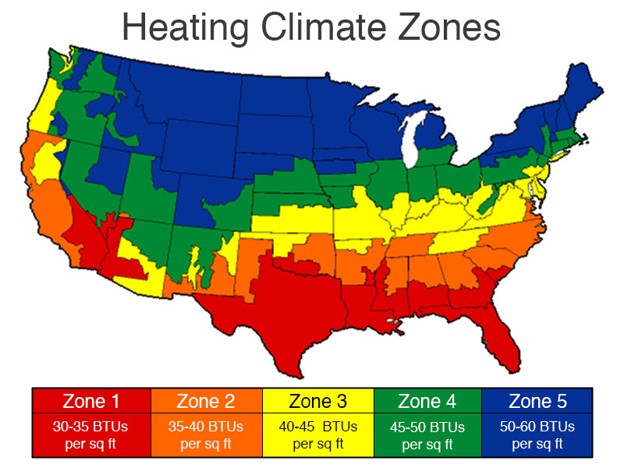
Figure 1 shows the Mason-Dixon Line per Encyclopedia Britannica. Figure 2 shows heating climate zones, which I use to recommend the dividing line between air-source and ground-source heat pump systems. Air source is probably fine for Zones 1 to 3. North of there, roughly the Mason-Dixon line, ground-source systems are recommended for performance, grid load minimization, and efficiency reasons.
Figure 1 Mason-Dixon Line

Figure 2 Heating Climate Zones
Ground and Air-Source Heat Pumps
On February 18, 2025, I wrote Boring DERs, Saving Billions with Geothermal [ground source] Heat Pumps. In that post, I showed how air-source heat pump efficiency drops precipitously, starting around 0F and colder. I have a cold-climate, air-source heat pump so that I can speak from direct experience. I don’t use it much below, mmm, 40F outdoor air temperature, because I have a condensing gas-fired boiler to heat the entire house. In this post, I calculated why 40F, even after my intuition said, “Yep, 40F is the right switchover point to natural gas.”
There are a couple of solutions to help electrify heating without breaking the grid and freezing buildings and people. The first is to use ground source technology, as noted in my 2025 post. Chat tells me the ACEEE report does not mention ground-source (geothermal) as a distinct technology and consistently uses the term “heat pumps,” which clearly refers to air-source heat pumps. I searched for “ground” and only found “groundwork” and “geothermal,” which returned nothing. So, I’m backing Chat’s findings.
Building Envelope
The second solution is vastly improved building envelopes (well-insulated walls and state-of-the-art windows). Also, in 2025, I analyzed a Wall Street Journal article in Windows Worth a View. The article said high-tech glass, like that used for cell phones, could help reduce heat loss by $200 to $400 per home, for a total of about $25 billion per year.
How? Cell phone glass is very thin and tough, so manufacturers can stack several sheets together, creating many inert-gas (argon) gaps between them to provide insulation. But residential windows are only part of the equation. The $25 billion for residential savings potential, per the WSJ, compared to $215 billion annually, in toto per ACEEE, is not out of line for either. Check.
Assumption Plausibility
Per Chat, the ACEEE paper says existing buildings can reduce heating and cooling loads by 40-50%. I see that the paper says loads can be reduced by 30-40% through building performance standards. Building performance standards are like mileage ratings for vehicles. However, the standards penalize/fine building owners for “excessive” consumption. Even with hefty fines looming, 30-40% savings is a tall hurdle to clear.
For example, in January, we published A Million Btu per Hour: Notes from a Glacial Chicago Hotel Room, for which I analyzed replacing all single-glazed, the-worst-you-can-get windows at the Downtown Chicago Marriott. The savings I estimated totaled at most $20,000 in natural gas. The estimated cost is $2 million, with a simple payback period of 100 years. Yeah, I get it. This is a “high” rise building, but it also has the worst imaginable windows.
The windows I replaced on my house a few years ago were double-pane but not cleanable, and their operation was crummy. At the price I paid, the likely simple payback period was ~300 years.
The bottom line is that retrofitting building envelopes for high performance is extremely challenging.
Heat Pumps are not Light Bulbs
The report states, “80% of existing buildings achieve 40–50% heating and cooling savings, along with smaller savings in other energy uses, and roughly double the amount of electric heat.”
That’s not going to happen, full stop. We are not talking about a technological evolution to LED that can screw into existing sockets. It’s a refrigeration cycle of mechanical means (compressors and fans), and the energy consumption doesn’t go from 100 Watts to 14 Watts = 86% reduction.
Heat Pump Efficiencies
Chat categorizes heat pump efficiency from the Air Conditioning, Heating, and Refrigeration Institute, AHRI, the gold standard in efficiency measurement, as follows:
- builder-grade units around HSPF 8–9
- mainstream units around 9–10
- premium units around 10–12
- some cold-climate products above 12
HSPF is the heating seasonal performance factor, which is the amount of heat delivered in Btu per Watt-hour of energy consumed. It is analogous to the energy efficiency ratio (EER) or seasonal EER (SEER) for cooling. The coefficient of performance (COP) is much easier to consume, which is probably why it’s not used. Lucifer hides behind nebulous factors like HSPF (isn’t that a sunscreen rating?) and SEER. These are like miles per gallon, but everyone knows what a mile and a gallon are. No one knows what a Btu or a Watt-hour is. COP is a simple and unitless ratio of output over input. Here is a comparison table from HSPF to COP:
HSPF | Approx. Seasonal COP |
8 | 2.35 |
9 | 2.64 |
10 | 2.93 |
11 | 3.22 |
12 | 3.52 |
Upgrading from standard-efficiency to super-premium heat pump efficiency reduces energy consumption by roughly 30%, not 85% as with an LED lightbulb. Plus, with heat pumps, we’re talking about a 20-year asset, not a one-year (incandescent) asset. People don’t burn through heat pumps like paper napkins. Opportunities for incremental upgrades are limited.
Conclusions
To reduce and minimize grid loads cost-effectively, do the following:
- Replace electric baseboard heating with heat pumps or natural gas heating.
- Air source is probably fine below the Mason-Dixon line.
- Ground source above the Mason-Dixon line.
- Natural gas heating, anywhere.
- Consider building envelope improvements for new construction or during envelope replacements (commercial roofing), or window replacements are necessary anyway.
- Assess multiple envelope “efficiency” options to find the sweet spot, considering energy consumption versus first cost.
- Perform sensitivity analysis on future energy (electricity, demand, and natural gas) costs.
I didn’t even get to peak load implications. Maybe next time.