Last week, I dived into the characteristics and selection factors of air compressors, focusing on full-load and part-load efficiencies. This week, I will round out my assessment of savings opportunities for compressed air systems.
First, I will define a couple of things: compressed air plant versus compressed air system.
A compressed air plant refers to the primary equipment that produces and conditions compressed air, and typically includes:
- Compressors (screw, centrifugal, reciprocating)
- Aftercoolers
- Dryers
- Filters
- Air receivers (sometimes)
- Controls/sequencing
A compressed air system refers to the entire ecosystem from the plant to the end-use loads. The system typically includes:
- Everything in the plant plus
- Distribution piping
- Storage (receivers throughout the system)
- End uses (tools, actuators, processes)
- Leaks
Controls and Sequencing
I touched on this last week, but to drive it home, ensure the best and most efficient unloading compressor is always putting the last unit of compressed air (cubic feet per minute, or cfm) into the system. I call this compressor the trim compressor. As discussed and demonstrated last week, the most efficient part-load, trim compressor is usually a lubricated screw compressor with integrated variable-speed controls.
It’s been a long time, but back in my day, I witnessed compressed air plants running willy nilly with several compressors, including ones with poor unloading performance, operating at part load. I have also seen operators rotate compressors to level out wear, using inefficient units to trim much of the time. Always use the most efficient trim compressor, even if it’s the only one in the plant.
Dryers
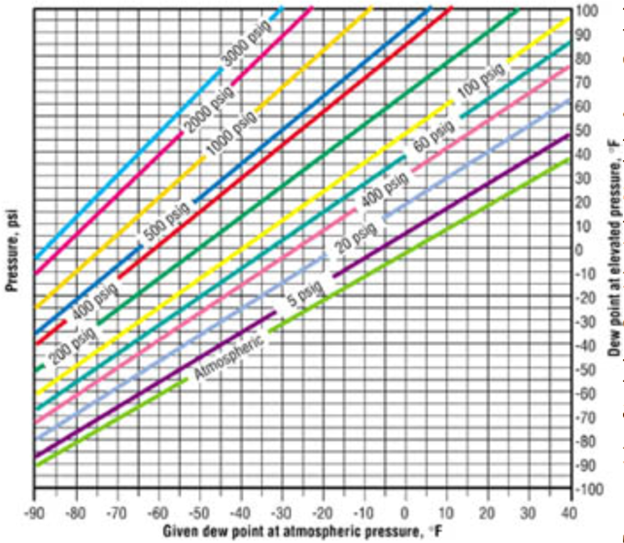
When air is compressed, the dew point of the air/water vapor mixture (ambient air) rises substantially. What does that mean? Water condenses and forms once the compressed air cools to ambient temperature in the plant/system. Figure 1[1] shows how the dew point rises as air is compressed. I’ll boil it down for you. Essentially, any time the outdoor air temperature is above 20-30 degrees, there will be condensate in the compressed air at 100 psig (pounds per square inch, gauge). In other words, there will almost always be condensate in the compressed air plant and system. The liquid must be removed.
Figure 1 Compressed Air Dew Points
There are two primary types of compressed air dryers: refrigerated and desiccant, both of which can also be used to dehumidify air in HVAC systems.
Refrigerated dryers dry air the same way air conditioning does. The compressed air is cooled to the desired pressure dew point to condense water out of the air-water mixture.
Desiccant dryers can achieve much lower dew points and should be reserved for specialty applications as in pharmaceutical, biotech, electronics, and semiconductor manufacturing. Desiccant materials absorb moisture but must be regenerated, generally with hot air, to drive the water off the desiccant so it can absorb water from the compressed air again. The regeneration differences are where the savings opportunities exist.
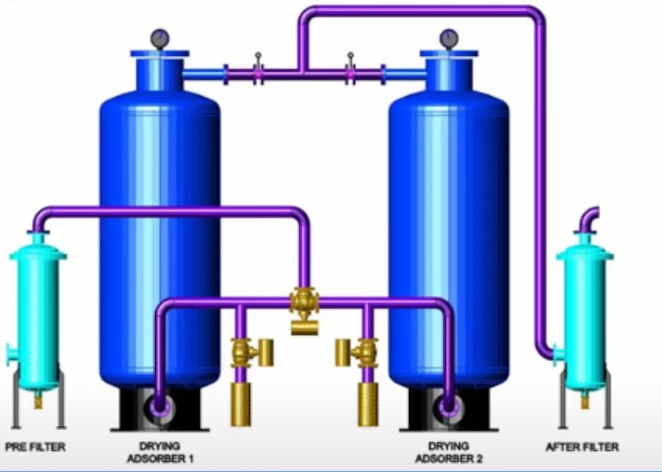
A cartoon of a desiccant dryer is shown in Figure 2. One blue tower dries compressed air while the other is being regenerated. The heatless desiccant dryer regenerates by expanding a portion of the dry, compressed air to near-atmospheric pressure and passing it through the saturated desiccant bed, where its low dew point strips the accumulated moisture and carries it out of the system. The cost is a lot of wasted compressed air, like 15-20% of the air flow.
Figure 2 Heatless Desiccant Dryer
Using heat reduces compressed air losses to 5-10%. Still better, a blower, rather than compressed air, and heat can be used to regenerate desiccant with even less compressed air loss, around 1-3%.
Bottom line:
- Don’t over-dry
- Minimized compressed air consumption for regenerating desiccant where desiccant is needed (minus 40F dewpoint)
- Install desiccant near the point of use if only a small fraction of compressed air needs ultra-dry air
Wasteful Uses of Compressed Air
Compressed air is one of the most energy-intensive and expensive utilities in a facility. This section describes wasteful applications to avoid.
Cooling
Compressed air provides cooling in two ways: by moving air and by causing a temperature drop as it expands. When air is compressed, it gets hot. When it expands, it cools. However, only 10-20% of the electricity consumed to generate compressed air is converted to useful energy at the point of use. Let me put it this way: cooling with compressed air is roughly 15% efficient while cooling with an ENERGYSTAR-rated air conditioner or chiller is 400% efficient.
Bottom line: Cooling with refrigeration is about 25 times more efficient than using compressed air. Don’t do it.
Cleaning and Debris Removal
Now that I’ve established how inefficient compressed air is, don’t use it to blow dust, debris, and filings around. Compressed air is a very expensive option for a broom or blower.
Sparging
Sparging is the process of injecting gas, often compressed air, into a liquid to promote mixing, mass transfer, or chemical reactions by creating bubbles that rise through the fluid. The pressure needed for sparging is much lower than the typical 100 psig of a compressed air system. Use lower-pressure blowers or mechanical mixers to do this work with much lower energy consumption.
Vacuum Pumps
Using the Bernoulli Principle (remember that?), we can draw a vacuum with compressed air. Sound dumb? It is, and because it can be done, it is, but it’s a horrible waste of compressed air. I’ve seen this in action myself, lifting buns out of baking tins in an industrial bakery. Instead, use a vacuum pump, specifically for the application.
Storage
We saw last week that storage can help reduce compressor plant energy consumption for lubricated screw compressors that require blowdown when cycling. A greater energy saver is often pressure reduction for the entire system.
Here is a typical poor fix to unacceptable pressure drops: there may be large surges in compressed air end use (hopefully not for cooling or cleaning) that excessively decrease system pressure. An expensive solution is to increase system pressure, using the system piping as storage. Not only does higher pressure require more power and energy, but more air is consumed because higher pressure generates more flow. Instead, install storage near the surge point so that when the surge hits, there is plenty of stored, compressed air to carry it through at the desired pressure.
Closing
Readers may recognize a pattern in my suggestions.
- Don’t use compressed air or blowers to do what some other technology, like refrigeration or vacuum pumps, can do with much less energy consumption. In many cases, the added cost of this equipment will pay for itself in no time.
- When compressed air is required, consider reducing pressure at the point of generation rather than using pressure-reducing valves (throttling) throughout the system.
- Lastly, fix leaks and stay on top of them constantly. The DOE estimates leaks are typically 20-30% of compressed air load!
[1]https://maintenanceworld.com/2013/07/27/drying-your-compressed-air-system-will-save-real-money/