
Last week, I mentioned I planned to write about toothpaste, only to be overtaken by more urgent headlines around data center moratoriums, power shortages, grid unreliability, and soaring electricity prices. This week I’m circling back to toothpaste, not because oral hygiene suddenly became an energy issue, but because a Bloomberg article about recyclable toothpaste tubes accidentally exposed something much larger: a collapse of proportionality in how we think about waste, regulation, and antitrust. When legal beagles can’t distinguish between trivial tube-design coordination and market-shaping and alignment of trillions of dollars in capital, we’ve lost the plot.
The crux of the Bloomberg article, “Green Toothpaste Tubes and the New Antitrust Battleground,” is that competitors in the toothpaste industry colluded to develop recyclable tubes, an anti-competitive practice. I couldn’t make this up if I tried. There are many tangents I can take with this. I’ll see how many I can knock out in the requisite 1000 words, including the 150 already typed.
The Scale of Plastic Waste
Toothpaste tube recycling is on par with the virtue-signaling absurdity of the plastic-straw crusade a few years ago. Bloomberg reports 38,000 tubes are tossed per minute worldwide. Simple math tells me that’s 20 billion tubes per year, or barely three tubes per person. That’s on par with my guess that I use one tube per quarter.
The tube itself is estimated to weigh about 25 grams. Feel free to do your own research, but many sources I triangulated corroborate that 25 grams is reasonable. The total annual plastic waste from toothpaste tubes is about 500,000 tonnes. This sounds big, but it’s not relative to total plastic waste.
Mother loads of plastic consumption and landfill bulk come from retail food (grocery) and especially takeout, which is one-and-done and a low-utilization use of plastic.
Total worldwide plastic production is around 460 million tonnes (toothpaste tubes: 0.1%). Forty percent of the total is used for packaging (0.27% toothpaste tubes). Half the plastic consumed for packaging is for food packaging (0.54% toothpaste tubes). Although this is a minute sliver of the total, it seems like an order of magnitude high to me, but let’s just let it ride.
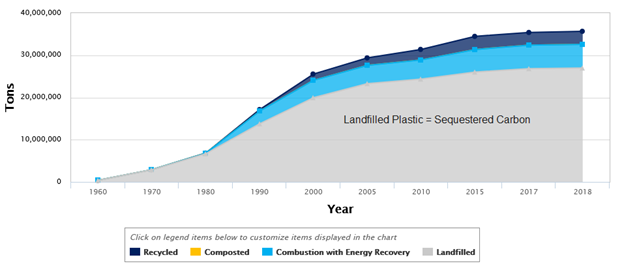
Did I mention plastic is sequestered carbon? EPA data show that about 75% of plastic is sequestered in landfills, excluding mismanaged plastic (litter).
Figure 1 U.S. Plastic Fate
Mismanaged and littered plastic includes leakage to the environment (litter) and other mismanaged (burned or inappropriately disposed or buried plastic) accounts for a whopping 19% of plastic.
Figure 2 Mismanaged and Littered Plastic
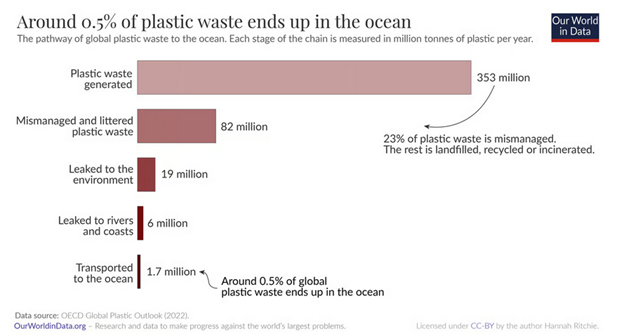
As for leakage, when was the last time you saw a toothpaste tube on a beach, in a roadside ditch, or amongst a filthy patch of cigarette butts at an intersection?
Takeout Waste
Takeout is the massive, low-utilization, high litter and contamination, and the least recycled plastic waste. In terms of plastic use, utilization reflects the product’s length of use and its necessity. Takeout plastic containers and flatware are used for a few minutes, not necessary, and then tossed, often leaking into the environment. Dissimilarly, there aren’t many alternatives for toothpaste containers.
The National Oceanic and Atmospheric Administration (NOAA) says top coastline rubbish includes food wrappers, beverage bottles, grocery bags, straws, and takeout containers, all made of plastic. Aha! Now we see the origin of the virtue-signaling straw ban – to feel good about the plastic bag, fork, knife, and plastic container they threw in the trash.
Unequal Antitrust
Finally, it’s absurd or entertaining (I choose the latter) to know that state attorneys general are shooting cannonballs across the bow of toothpaste manufacturers, especially Colgate (Palmolive), for sharing waste-reducing packaging with rivals to make packaging more recyclable.
“According to the attorneys general, companies cooperating to make packaging easier to recycle and reuse are pushing environmental standards that haven’t been approved by voters.” Environmental standards? Approved by voters? That is absurd. This is why politicians are loathed. Attorneys general are politicians. Makey no mistakey.
The article references 2023 AG investigations into banking companies for antitrust violations related to environmental, social, and governance (ESG) initiatives. ESG is in another league. There is a big difference in working together to solve packaging issues and railroading the larger economy according to the whims of Larry Fink.
Antitrust Conclusion
Humans must exercise judgment about where antitrust scrutiny matters and where it is misplaced. Coordinated ESG lending requirements that steer trillions of dollars of capital, raise borrowing costs for disfavored industries (natural gas and gasoline) that especially impact low-income folks. ESG requirements can reprice entire sectors of the economy. That is categorically different from toothpaste manufacturers agreeing on a recyclable tube design. The former alters capital allocation at national and global scales. The latter marginally changes a piece of packaging that no consumer notices and no market depends on. Treating both as equivalent antitrust threats collapses an essential distinction between coordination that reshapes markets and coordination that is, for all practical purposes, innocuous.
The bottom line is that AI and law have something in common: both can support or reinforce nonsense. Humans need to intervene and use common sense to decipher the difference.