

- Efficiency is not deprivation (sometimes).
- Efficiency is a core enabler of sustainability, competitiveness, and resiliency.
- Modern efficiency is powered by electrification and digitalization.
- Efficiency delivers value beyond savings, including increased productivity, lower maintenance costs, and more.
- Efficiency strengthens appeal.
- Efficiency is Not Deprivation
In the article’s first point, efficiency doesn’t mean deprivation, unless it does.
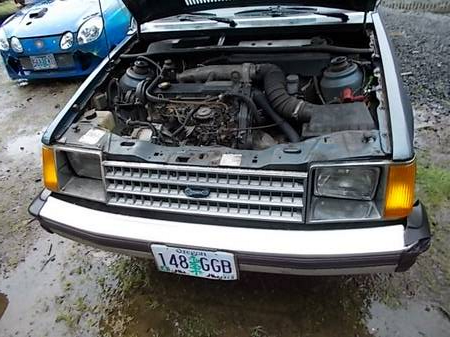
In my college days, I was more of an efficiency freak than I am today. In 1986, I bought a 1984 Ford Escort diesel. Most people were unaware of their existence. An image of the prime mover (engine) is provided from this blog in Figure 1.
Back then, I didn’t care if the zero-to-60 mph took 90 seconds or the speed in the quarter mile was 42 mph. The car got about 50 miles per gallon of diesel fuel. And I must say, back then, I had range anxiety like modern-day EV drivers. One time in the Twin Cities metro area, I was desperate to find a “filling station” that offered diesel fuel. Back then, diesel fuel for cars and light trucks was a nascent thing, but I lucked out and wasn’t stranded.
Figure 1 Ford Escort Diesel Prime Mover
I wouldn’t buy that car today, even if it had all the modern features, touch screen, Apple CarPlay, and navigation – so much stuff that I can’t figure out how to turn off the radio. I need to hire a 17-year-old who doesn’t know how to drive to figure out the car and then hope they don’t crash it in the process.
I must add that it was the only car I owned without power steering. It was a great feature for driving on ice because the slippage was easily detectable through the steering mechanism.
Efficiency Enables Sustainability, Competitiveness, and Resilience
This one is probably the most worn-out selling point of energy efficiency projects. I would bring a solution to a problem with efficiency to get it over the line. We can bring a project with a simple payback of under two years, or even one year, to a customer, and, like a finicky musky, they’ll say, ‘Nope!’ No bite here. They often prefer to pour their capital into growing their core business.
Okay, Mx. Customer, the next option could be that we buy the whole thing and run it for you, then sell the service to you. It could be any of the heating, refrigeration, or air conditioning services, or other utilities, such as compressed air. In such cases, customers maintain capital for expansion (competitiveness), increase cash flow for leverage, and can also incorporate a sustainability spin for their customers, possibly.
As for resilience, I can’t think of many plays, other than IceRack that provide efficiency, load management, and resilience at the same time. Resilience is provided through protection against refrigeration-system evaporator or compressor failure, as well as resilience from electrical power outages. And by golly, IceRack can be quickly deployed as a backup asset on the grid to relieve stress on feeder, substation, and bulk-power systems.
Efficiency and Digitalization – I.e., Technology
For several years, in my electrification presentation for the Wisconsin Public Utility Institute’s Energy Utility Basics curriculum, I have mentioned that one reason electric vehicle uptake has not jumped the chasm is that they are not a must-have innovation like a smartphone. Others have caught on. The Wall Street Journal quotes a McKinsey guy, who I am sure is much better compensated than I, “’ There’s this realization that, ‘Hey, this transformation isn’t going as fast as we want,’ said Patrick Schaufuss, a partner at consulting firm McKinsey. ‘EVs aren’t smartphones.’” In another WSJ article that describes Ford’s looming surrender on the disastrous F150 Lightning, the subheadline reads, “Once hyped as a ‘smartphone that can tow,’ production of the money-losing EV pickup may be shut down for good.”
I recently met a unique diehard Tesla fan. What was the selling point for her? None of the ones listed in Deloitte’s preferences for EVs, shown in Table 1. Fuel cost? Nope. Environmental benefits? Puh-leeze. It is the unmatched self-driving feature, which is very impressive. On the other hand, my 2022 VW GTI has a self-driving feature for freeway driving – similar to a dumb phone versus Tesla’s self-driving smartphone. VW’s self-driving technology gets an F-minus from me. It’s horrible, telling me to take the wheel when I have both hands on the wheel, driving right down the middle of the lane on a sunny day with no one in front of me. It even throws an alarm in that situation and slams on the brakes. What’s not to love? At best, that technology might help a little in a sleepy-driver situation.
Table 1 Consumer Preferences for Electric Vehicles
Reason | Survey Result |
Lower fuel costs | 56% |
Concern for the environment | 44% |
Driving experience | 36% |
Less maintenance | 30% |
Government incentives/subsidies/stimulus programs | 27% |
Ability to use the vehicle as a backup battery/power source | 25% |
Concern about personal health | 20% |
Potential for extra taxes/levies applied to internal combustion vehicles | 18% |
Potential ban on sale of new internal combustion vehicles | 17% |
Peer pressure | 3% |
Total | 276% |
Electric vehicles are not smartphones, but they could be, just like every other ICE-powered vehicle.
Efficiency Beyond Savings
Efficiency’s Appeal
I made a pop-culture comparison of efficiency versus renewable energy ten years ago. I’d say the analogy endures to this day. Energy efficiency is the homely Albert Einstein. I’ve got the brains. You’ve got the looks. Let’s make lots of money.
Conclusion
This post features five perspectives on energy efficiency. Frankly, that’s about the weight that energy savings have on customer decisions to deploy efficiency measures (20%). Most of the reasons customers choose to implement energy-saving projects are non-energy related. I’d bet on that. But don’t tell the net-to-gross inmates, or suddenly, the maximum attribution will be 20%. Like parasites, they’ll kill the engine we all rely upon.