A year or two ago, around the time Hertz flooded the market with its fleet of electric vehicles, I heard from EV industry enthusiasts that the electric vehicle revolution was going through some chop, and that no transformation grows straight up. Correct. Usually, market adoption curves look like an S curve, as shown in Figure 1.
Figure 1 Market Adoption S-Curve
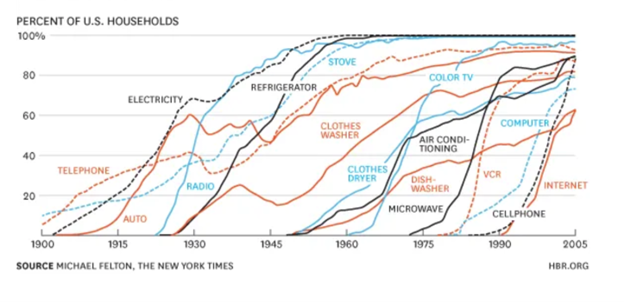
The hope among EV evangelists may have been that their curve would look like the clothes washer adoption curve. However, that dip was due to World War II. Appliance production was curtailed during the war[1][2] as those factories were converted to manufacture items to win the war.
Riding the Hype Cycle
Instead, I would say the EV market is speeding downhill in the Gartner Hype Cycle curve shown in Figure 2, taken from a LinkedIn post and borrowed from McKinsey. It’s interesting to look back at that ~year-old post, showing that the nadir was on the doorstep in 2024. Not so. The Wall Street Journal recently reported “Detroit Automakers Take $50 Billion Hit as EV Bubble Bursts.” See Figure 3 for an excerpt from that article. For the dagger, the article quotes Ford CEO Jim Farley, “Instead of plowing billions into the future knowing these large EVs will never make money, we are pivoting.” Wow. That’s facing reality.
Figure 2 EV Gartner Hype Cycle
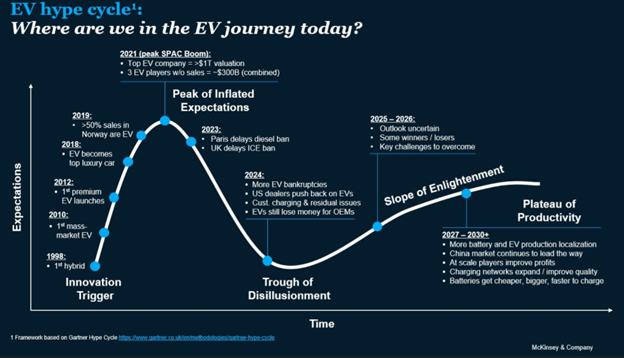
Figure 3 Monthly EV Sales
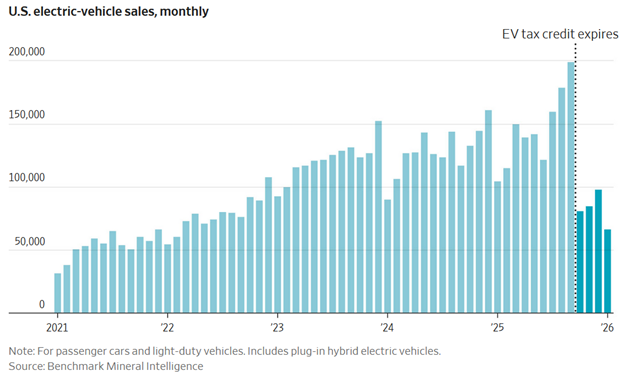
The WSJ article goes on to say, “Now, auto companies and battery makers are scaling back. After pouring hundreds of billions of dollars into U.S. manufacturing, they are downsizing investments, canceling projects, and pivoting plants to support making more traditional gas-powered vehicles.”
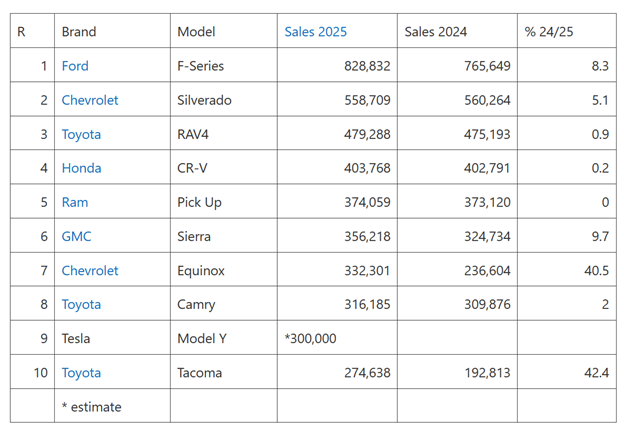
Frankly, I don’t know what Ford was thinking when they put a massive pile of chips behind the all-electric F-150 Lightning truck. Was it their version of Coca-Cola’s 1985 release of New Coke? Astonishingly, the top seven selling vehicles in the United States, per Table 1, courtesy of BestSellingCars.com, were light trucks and sport utility vehicles. Four of the top seven were full-sized, gas-guzzling pickup trucks.
Table 1 Top-Selling Light Vehicles in the United States 2025
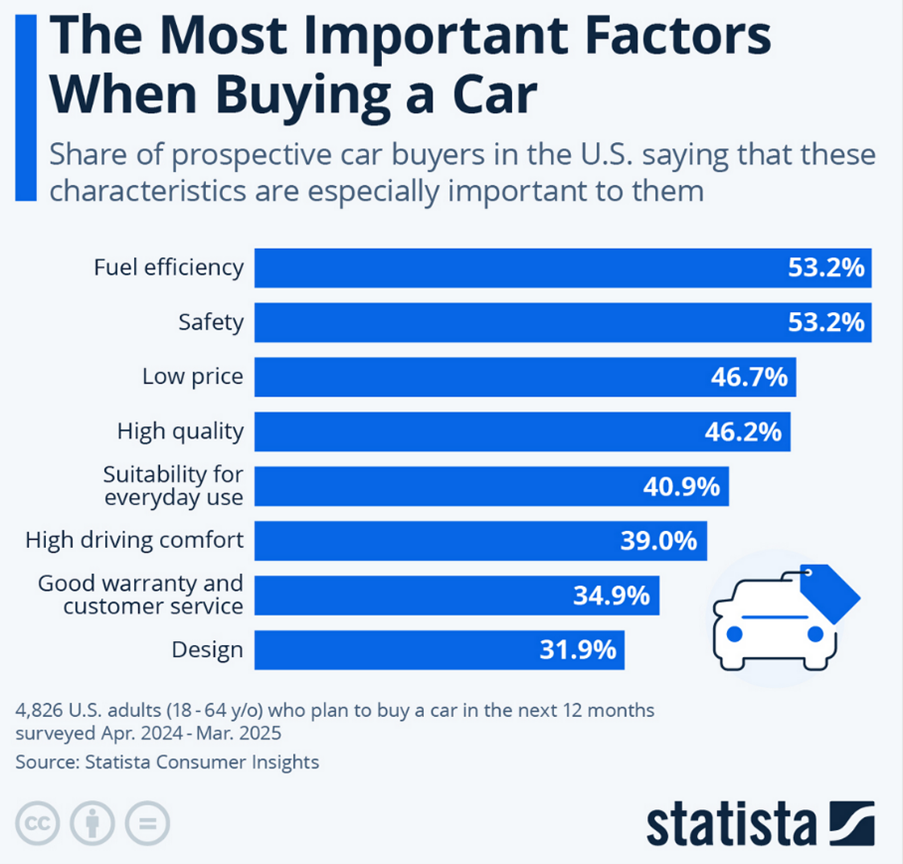
There is a significant cognitive dissonance in Americans’ stated car-buying preferences and their behavior. They say they favor fuel economy, safety, and low price in order as the top three criteria. See Figure 4. As Meat Loaf belted out, two out of three ain’t bad [maybe]. One out of three is bad. At least EVs get two out of three.
Figure 4 American’s Car-Buying Priorities
Vehicle to Home and Tough Guy Wannabees
Remember the Ford Lightning vehicle-to-home pitch from a few years ago? Here is a video reminder. Nice try. Tough guys like batteries for drills and saws because they provide cord-free, remote power in the field, and they’re swappable. Electric trucks do the opposite by making refueling more of a hassle. The majority of Lightning buyers (63%) were tough-guy wannabees entering the truck market for the first time. Only 15% flipped their gas-fired F-150 for a Lightning. That spells doom, Mr. Farley. There are less expensive alternatives to construction and farming trucks and backup power, such as a $10,000 natural gas backup generator.
Overly Complicated Vehicle to Grid
Moving a step beyond vehicle-to-home, there was vehicle-to-grid (V2G), which, for most applications, is another poorly hatched idea. Who wants to drain their fuel tank for a few dollars to add to the range anxiety? How about that $10,000 gas-fired generator that can supply the grid with zero lost stored energy? That alone demonstrates the absurdity of V2G for personally-owned vehicles (POVs). Why do people buy automobiles in the first place? Autonomy and freedom to go anywhere at any time. A vehicle is not a stationary asset bolted to the garage floor. 🙄
Here is a list of engineering and other issues with VTG:
Technical & Infrastructure Issues
- Lack of standardization across EVs, chargers, and grids creates interoperability challenges.
- Specialized bidirectional chargers and hardware are required; most existing infrastructure is one-way.
- Grid integration complexity: legacy grid systems are not designed for widespread bidirectional flows.
- Round-trip energy losses and conversion inefficiencies reduce overall system effectiveness.
- Sophisticated real-time energy management and communication systems are required.
Battery & Owner Concerns
- Potential accelerated battery degradation from frequent charge/discharge cycles.
- Unclear economic return for vehicle owners participating in grid services.
Grid & Operational Barriers
- Grid stability concerns due to unpredictable vehicle connection and disconnection patterns.
- Smart charging and advanced metering infrastructure are still limited in many regions.
Communication & Security
- Heavy reliance on secure, real-time data exchange increases cybersecurity risks.
- Immature or inconsistently implemented communication protocols (e.g., ISO 15118).
Regulatory & Market Challenges
- Regulatory frameworks lag technological capability.
- Compensation mechanisms for EV owners providing grid services remain unclear or inconsistent.
Consumer Acceptance
- Owners are concerned about losing mobility flexibility if battery charge is reduced to meet grid needs.
Sound Grid Support With EVs
Thinking just a little, what could be a good V2G application? How about a school bus that is used for an hour or two a day, many of which are stationary assets during summer peak grid loads, or winter weekend peaks? That seems like an opportunity with potential.
The primary opportunity for grid support and EVs is managed charging. Don’t overcomplicate it.
[1]https://gdonna.com/living-like-the-past/laundry-during-the-1930s-and-1940s/?utm_source=chatgpt.com
[2]https://en.wikipedia.org/wiki/Louis_Upton?utm_source=chatgpt.com