

Written by guest blogger Liz Haworth, VP of Marketing at Michaels Energy
Jeff is out of town, which means the Energy Rant microphone landed on my desk. As Michaels Energy’s marketing lead and current Chair of the AESP Board, I spend a lot of time thinking about how the energy efficiency industry communicates its value. Lately, one thing keeps bothering me.
If you follow energy news long enough, you start noticing a pattern. Demand forecasts go up, alarm bells ring, and the industry response is almost always the same: build more stuff. More generation. More transmission. More infrastructure. Rinse and repeat.
That instinct made sense for most of the last century, but the grid we’re operating today and building for tomorrow looks very different. Electrification is accelerating, data centers are multiplying, AI is adding load faster than planners expected even two years ago, and utilities are trying to balance reliability, affordability, and decarbonization all at the same time.
It’s a complicated equation, but there’s one part of the solution we continue to overlook. We keep talking about how to build more energy while ignoring the fastest resource we already have: energy efficiency.

Efficiency is often the quickest, cheapest, and least disruptive way to meet growing demand. Yet the industry still treats it like a side project rather than a core strategy.
From a marketing perspective, it’s like spending your entire budget on new lead generation while ignoring the customers already sitting in your pipeline. Sure, new leads are exciting. They’re shiny, they make the dashboard graphs go up, and of course you still need them for long-term growth. But any decent marketer will tell you the fastest revenue often comes from the opportunities you already have.
Energy efficiency is the grid’s existing pipeline – and we’re leaving a lot of opportunity sitting there untouched. As Jeff has pointed out in All Aboard the Less for More Train, the easiest megawatt to manage is the one you never have to generate in the first place.
The Energy Industry Loves Supply-Side Solutions
Part of the reason efficiency gets overlooked is cultural. The energy industry has always been very good at building things. When demand increases, the default response is to add supply: new plants, new infrastructure, new technology.
But building our way out of today’s grid challenges will take time – and a lot of money. New generation projects take years to permit and construct, and transmission infrastructure can take even longer. Meanwhile, demand isn’t waiting patiently for the grid to catch up. Efficiency, on the other hand, can often be deployed immediately.
Programs Are Still Stuck in Yesterday’s Model
Despite that reality, many efficiency programs still reflect models developed decades ago: prescriptive incentives, equipment lists, and rebates tied to individual widgets. Those approaches worked well when the goal was replacing inefficient lighting or encouraging adoption of high-efficiency motors and appliances. But the opportunity today is far bigger than swapping out equipment.
The real frontier of efficiency is operational. It’s about optimizing systems rather than just upgrading components. Buildings that adapt to real-time conditions instead of running on static schedules, industrial processes that continuously tune performance, and facilities that treat energy management as an ongoing discipline rather than a one-time project.
At Michaels Energy, much of our work in retro-commissioning (RCx) and strategic energy management (SEM) focuses on exactly this kind of operational improvement because the savings potential is enormous.
The Grid Needs Flexibility, Not Just Generation
Another piece of the conversation that deserves more attention is flexibility. Efficiency and demand flexibility are often treated as separate ideas, but in practice they’re closely related. Reducing peak demand can be just as valuable to the grid as reducing total consumption.
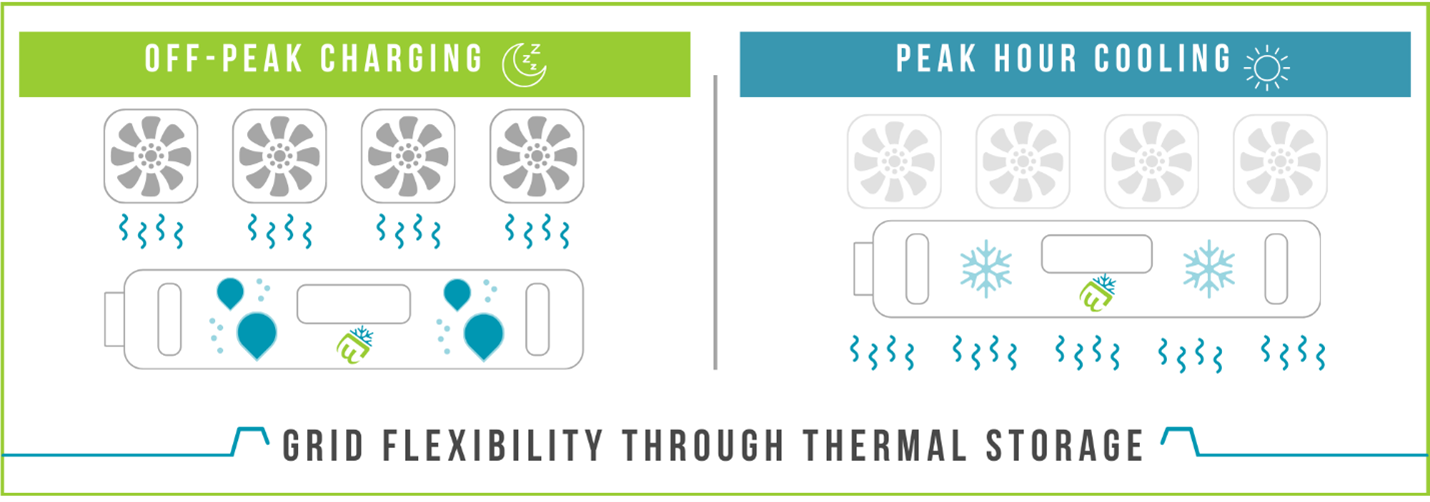
Technologies like thermal energy storage illustrate the point well. Systems like IceRack™ thermal energy storage allow facilities to store cooling energy when electricity demand is low and use it during peak hours. The building still gets the cooling it needs, but the grid avoids a spike in demand when capacity is most constrained. Solutions like this reduce peak load, lower operating costs, and improve grid stability – all without building another power plant.
The challenge is that these kinds of solutions don’t always fit neatly into traditional program frameworks. They live somewhere between efficiency, demand response, and storage, which can make them harder to categorize and incentivize.
Jeff touched on this disconnect in Demand Response Is Not a Program, It’s a Strategy, where he argues that we need to think about grid solutions more holistically instead of forcing them into old program boxes.
The Next Phase of Efficiency
One of the privileges of serving as Chair of the AESP Board is seeing the breadth of ideas emerging across the efficiency industry. Utilities, regulators, implementers, and technology providers are all exploring new ways to unlock savings. The innovation is there. What we need now is the willingness to scale it.
At this year’s AESP Annual Conference, keynote speaker Esteban Gast reminded us that bringing a little humor and humanity into energy conversations can help people hear ideas they might otherwise tune out. In an industry as complex as ours, that matters. Many of the solutions we need aren’t new breakthroughs; they’re ideas we already understand but haven’t fully embraced yet.
The energy transition will absolutely require new infrastructure. There’s no getting around that. But it will also require us to use the infrastructure we already have more intelligently.
Right now, the biggest opportunity to do that is still hiding in plain sight.