
How to get paid for flexibility without risking product
Demand response is usually introduced to cold storage like this: “Would you like to reduce electricity use when the grid needs help?”
The operator hears: “Would you like to gamble with several million dollars of frozen inventory?”
Fair reaction. If your sales pitch sounds like a product recall with a rebate, expect a short meeting.
But demand response does not have to mean sacrificing cooling. It means engineering flexibility into when equipment uses electricity. The freezer keeps doing its job. The meter gets a different assignment.
What the grid is actually buying
Think of demand response as getting rewarded for using less electricity when everyone else needs more. Demand response programs rewards customers for changing electricity use when prices or grid conditions call for it. Depending on the program, payments cover availability, measured performance, or both. The grid is buying a dependable response—not an enthusiastic promise from someone who has never opened the freezer door.
During high-demand periods, think a hot summer afternoon, operators may dispatch peaker plants to supplement supply. These plants can have higher pollution rates than other generators. Reducing demand offers another way to balance the system. That is where your refrigeration flexibility becomes valuable.
Show me the money—without the spreadsheet
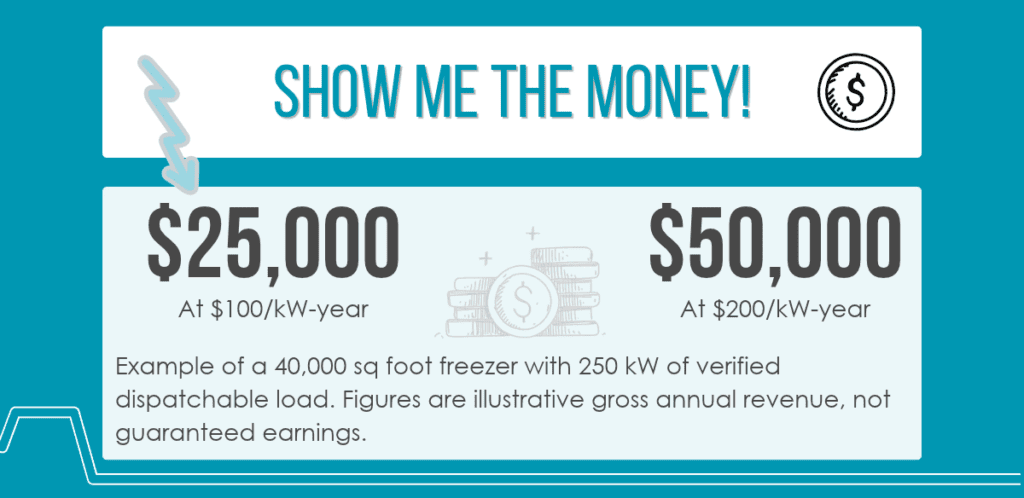
Here’s an example of the revenue potential DR provides.
- A 40,000-square-foot freezer with 250 kW of verified, dispatchable load.
- At $100/kW-year, that represents $25,000 in gross annual revenue.
- At $200/kW-year, it’s $50,000.
This is just one example, not a rate card—or a promise that every room that size can shed 250 kW. Actual payments will depend on location, enrollment, performance, and contract terms.
The important word is verified. The program pays for eligible performance, not the compressor nameplates you added up during lunch. Confirm how the program establishes your normal load and measures the reduction.
Why operators say “no”—and why they are right to ask questions
What happens when an event overlaps a shipment of warmer-than-usual product? How long can the reduction last? Who stops it if temperatures approach their limits?
These are not objections to innovation. They are the questions separating an engineered project from an expensive experiment. Product protection belongs in the operating sequence, not in the proposal’s comforting adjectives.
The cold-chain approach: shift, don’t gamble
Refrigerated-warehouse demand response strategies include pre-cooling, capacity limiting, defrost adjustments, and battery-charger scheduling. Applied within product and equipment limits, they move work rather than abandon it.
Thermal energy storage, including IceRack, adds stored cooling that can support temperature control while compressors reduce their electrical demand. Storage duration and discharge capability must match the event. A thermal battery is useful. An imaginary bottomless one is not.
Start with nonessential loads where practical. Coordinate defrost instead of allowing every evaporator to declare independence. Pre-cool only where product specifications allow, and confirm enough capacity remains afterward to recover and recharge.
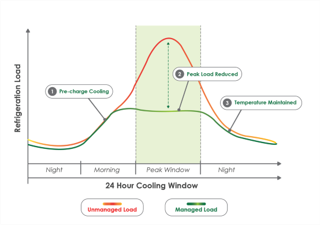
Illustrative demand profile—not measured site data. Charging and recovery must be included when evaluating total energy and emissions.
Rules of engagement: no improvising with inventory
Before enrolling, establish temperature limits, available storage, event duration, and a clear override that restores cooling when needed. Test the sequence under representative operating conditions. Commit to the load reduction you can repeat—not your best-ever result on a quiet Sunday.
Automate the response and monitor both temperatures and electrical demand. A smaller kW number is not a victory if the product is warming beyond its limits. Conversely, safe temperatures alone do not prove you delivered the contracted reduction.
Then plan the exit. Bringing every compressor back simultaneously can create a rebound peak. Collecting a DR payment and immediately handing some of it back through demand charges is an impressively circular business model.
NYC: where flexibility has an actual job description
Con Edison’s Commercial System Relief Program pays eligible customers to reduce demand during designated events. NYISO’s Special Case Resources program provides another route through capacity-market participation.
The lesson is not “move your freezer to Manhattan.” It is to match the facility’s capabilities to the program’s obligations. Notice periods, event duration, baselines, and overlapping commitments matter. A bigger advertised payment is not automatically a better fit.
The carbon part: the atmosphere does not accept marketing math
Reducing demand when fossil fuel generation is working overtime can avoid emissions. But moving electricity use is not automatically the same as eliminating it. Charging storage and recovering afterward also use electricity. The carbon result depends on the entire cycle and the generation being used during those hours.
If you want to put numbers behind avoided emissions, use an hourly analysis tool such as EPA’s AVERT and forward-looking Cambium data to evaluate that tradeoff. Cheap electricity is not automatically clean electricity, and one freezer cannot promise to shut down a particular peaker plant.
That is the decarbonization opportunity: reduce avoidable energy use, shift flexible cooling toward lower-emission hours, and verify the outcome. The carbon claim should survive the same scrutiny as the revenue forecast.
Bottom line: sell flexibility, not temperature risk
Your facility’s first job is protecting food. Demand response should pay for flexibility you can prove—not bravery you hope nobody notices.
Engineer the response. Test it. Measure the revenue and emissions impact. Keep product protection in charge.
The grid needs fewer kilowatts at the right time—not warmer ice cream. Sell it the first. Never negotiate on the second.