When estimating the lifetime savings of an energy efficient improvement, programs often assume the first-year savings carry steadily over the expected life of the equipment. In the real world, however, the actual savings may decrease over time, resulting in lower than expected savings persistence. Less discussed is the fact that it may take some time for users to maximize savings.
When I installed a heat pump at my home a few years ago, my contractor had a lot of trouble configuring it to work with my smart thermostat and my backup furnace. It took a full heating season of trial and error to operate more or less as designed. Even then, because the system is using components from multiple manufacturers, it may not operate as efficiently as it could.
In an earlier post, I explained that savings persistence can be thought of as having three elements:
- Technical Measure Life: The rated lifetime (and related failures) that a piece of equipment can technically last in a lab
- Measure Persistence: A factor that accounts for real-life failures and other reasons why the measure may not be in use, such as early retirement, business turnover, remodeling/renovations, and storm damage
- Savings Persistence: A factor that accounts for changes to the facility/operations (e.g., changes to hours of operation), behavior (e.g., training, commissioning), and efficiency degradation
Note that the performance/efficiency of both baseline equipment and efficient equipment degrades over time, usually at close enough of the same rate. We really only care about the net degradation of efficient equipment compared to baseline equipment.
Commissioning
Savings persistence is most often thought of as a decrease in performance later in the equipment’s life due to a variety of factors (operational, behavioral, technological). But issues beginning at installation can also lead to lower savings persistence. These issues may be caused by inferior installation practices, poor integration with controls or other equipment, or behavior. The way around this is for programs and contractors to focus on quality installation practices and commissioning. Commissioning is the systematic process of ensuring that systems are designed and operating as intended at the time of installation. This is usually focused on in the commercial sector, but it can apply to the residential sector as well, especially for heat pumps.
To facilitate the proper commissioning of residential heat pumps, NEEA, the national labs, and various OEMs have developed “connected commissioning.” As described in this paper, connected commissioning uses embedded sensors connected to an application that confirms that the system meets the manufacturer’s criteria for proper performance. As the paper describes, “the key advantage of connected-commissioning-capable equipment is that it is tailored to the manufacturer’s unique product design and installation requirements. This is especially valuable in variable-speed systems, which require multidimensional interpolation of operating conditions and parameters, and which currently require searching for specific hardware manuals or databases.”
Even a well commissioned building or system can have performance degradation over time. Retro-commissioning (RCx) is the systematic process of identifying and implementing improvements to increase the energy performance of existing buildings. It can involve both the installation of energy-saving equipment (e.g., occupancy sensors) and the adoption of energy-saving operational and control strategies to restore a building to its peak operational performance.
Simplified Examples
The chart below provides some simplified examples of how an energy efficiency measure’s savings persistence may play out.
- Constant Decline – In this example, the equipment was properly installed, but the savings decline over time.
- Reduced Consistent Savings – In this example, the equipment was not installed correctly, but there was no decline in savings over time.
- First Year Limited Savings – This example is like my heat pump issue, where savings were limited for an initial period but full savings were eventually realized.
- Retro-Commissioning – In this example, a system was not properly commissioned when installed, resulting in lower than expected savings. It then experienced a decline in savings over time but then was retro-commissioned to bring it up to the expected savings level. After that, the system continued to experience a decline in savings due to various factors (operational, behavior, technological).
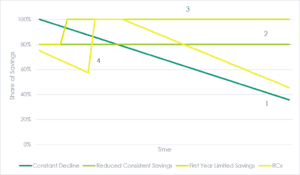
Each of these scenarios would result in lower than expected lifetime energy and bill savings, but each would bring their own issues. For example, systems that were not properly installed or commissioned might result in a low realization rate when evaluated as well as potential customer satisfaction and/or comfort issues. Evaluators should consider which curve might apply to a given installation and consider how to best extrapolate the results to the broader population of projects.