
There is a phrase in refrigeration that should make both Maintenance and Sustainability twitch: “We just topped it off.”
Restoring the refrigerant charge may get you through an immediate problem. Repeating the exercise without addressing the leak turns maintenance into a subscription service. Your refrigerant supplier gets recurring revenue. You get recurring emissions.
Two kinds of carbon—and neither accepts excuses
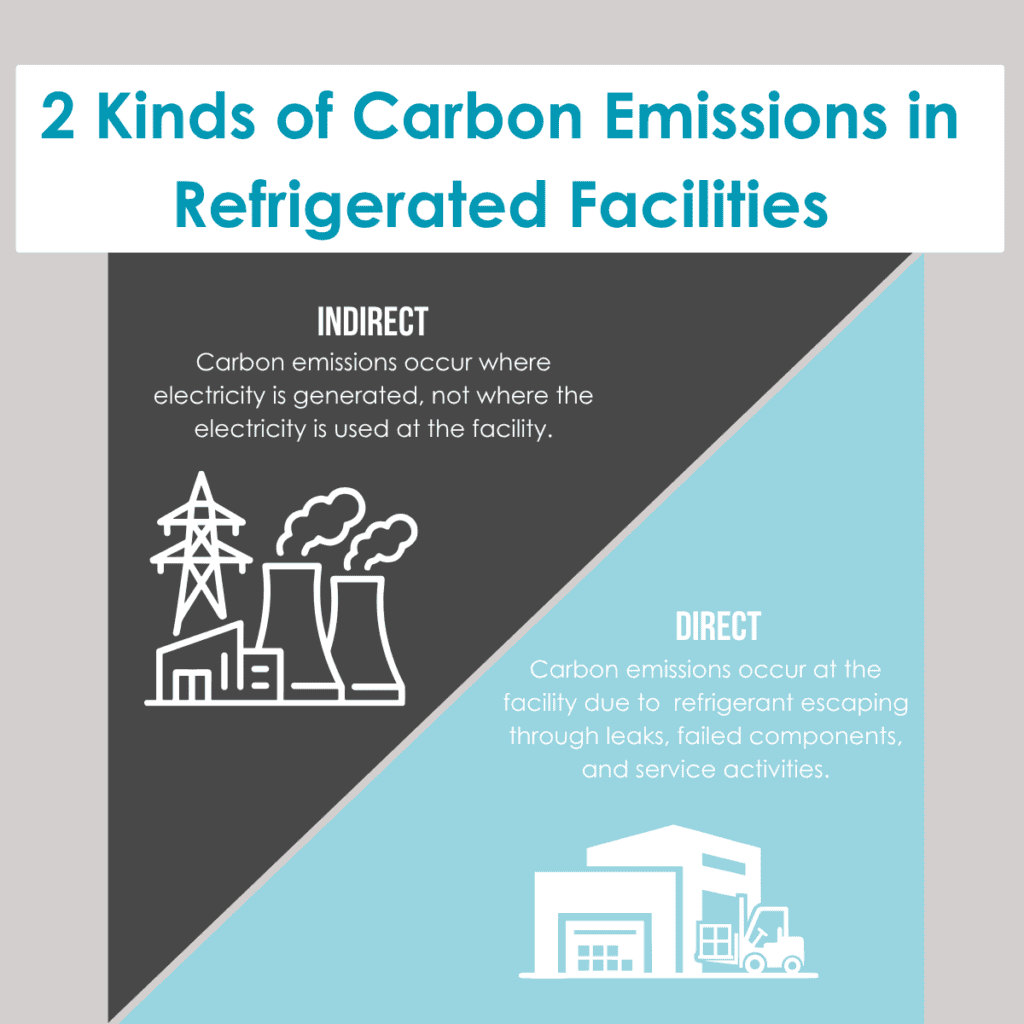
Refrigeration has two major emissions pathways. Indirect emissions come from the electricity powering compressors, fans, defrost, and supporting equipment. Direct emissions come from refrigerant escaping through leaks, failed components, or service losses. For many hydrofluorocarbon (HFC) refrigerants, global warming potential (GWP) is hundreds or thousands of times greater than CO₂ per unit of mass. That makes a small-looking leak a potentially large climate problem. Efficiency, controls, and thermal energy storage still matter. But shifting compressor work cannot seal a valve. A smaller electric bill is not permission to ignore what is leaving the pipes.
Leak reality check: “normal” is not a target
EPA’s 2022 GreenChill report cites a historical estimated supermarket-industry leak rate of 25%, compared with participating companies’ average refrigerant emissions rate of 12.9% in 2021. These are food-retail benchmarks—not a measured average for every cold-storage warehouse. Still, losing a quarter of a system’s charge annually deserves more than a shrug. The GreenChill results show that better technology and maintenance practices can reduce losses. “That’s just how these systems are” is not an engineering conclusion. It is an expensive surrender.
Where leaks come from: the usual suspects
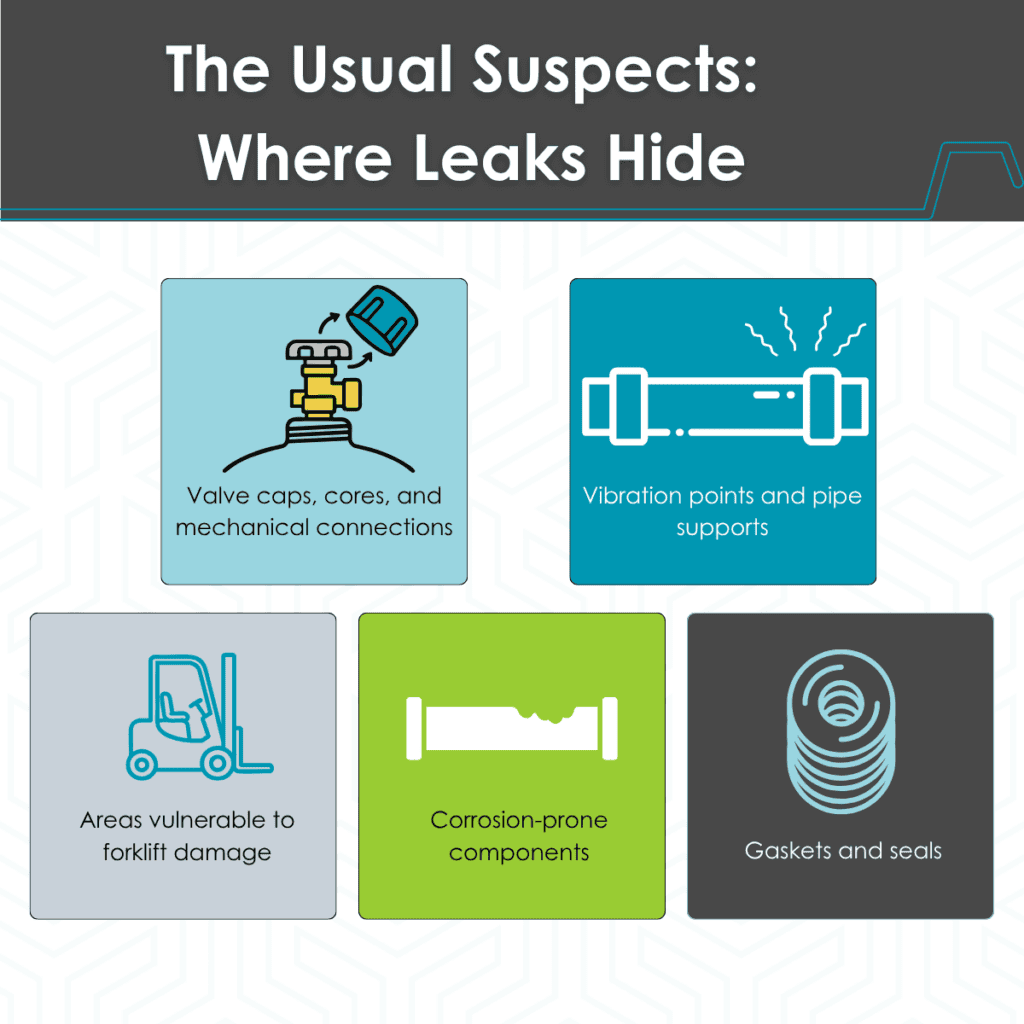
Think aging gaskets, missing valve caps, corroded components, and piping rubbing against supports. Vibration and thermal cycling can turn a minor installation detail into a persistent leak. None of these components will email you an apology. The warning signs may be less dramatic than a warm freezer: changing operating conditions, declining performance, or another unexplained charge addition. Investigate the cause rather than automatically blaming summer. When lost refrigerant compromises cooling performance, the issue moves beyond the carbon inventory and into product protection. Catch it while it is still a maintenance job—not after it becomes an inventory discussion.
Leak management does not require psychic powers
Start by tracking refrigerant additions by system, quantity, date, and reason. Compare the service history with the equipment’s charge size. Three invoices for the same rack should trigger a conversation—not a fourth purchase order. Build routine inspections, targeted detection, and repair verification into maintenance. Give each finding an owner. Confirm the repair, document it, and check for recurrence. An alarm without a response plan is just an expensive way to announce that something is getting worse. The work order is not finished just because the temperature looks better.
For 2026, EPA’s HFC-management requirements include leak repair for covered equipment with charges of 15 pounds or more, subject to refrigerant and equipment criteria. Separate Section 608 requirements apply to certain ozone-depleting refrigerants. Confirm which rules apply to your equipment; one threshold does not cover everything.
The phasedown era: “later” needs a budget
The AIM Act requires an 85% phasedown in HFC production and consumption from historic baseline levels by 2036. EPA’s Technology Transitions program also restricts higher-GWP refrigerants in specified new equipment and systems. Globally, the Kigali Amendment sets phasedown schedules across country groups.
That does not mean every existing rack must be replaced tomorrow. It does mean refrigerant availability, service options, and replacement planning deserve attention before a failure makes the decision for you. “We’ll deal with it later” is not a procurement strategy.
The retrofit trap: low-GWP is not a sticker swap
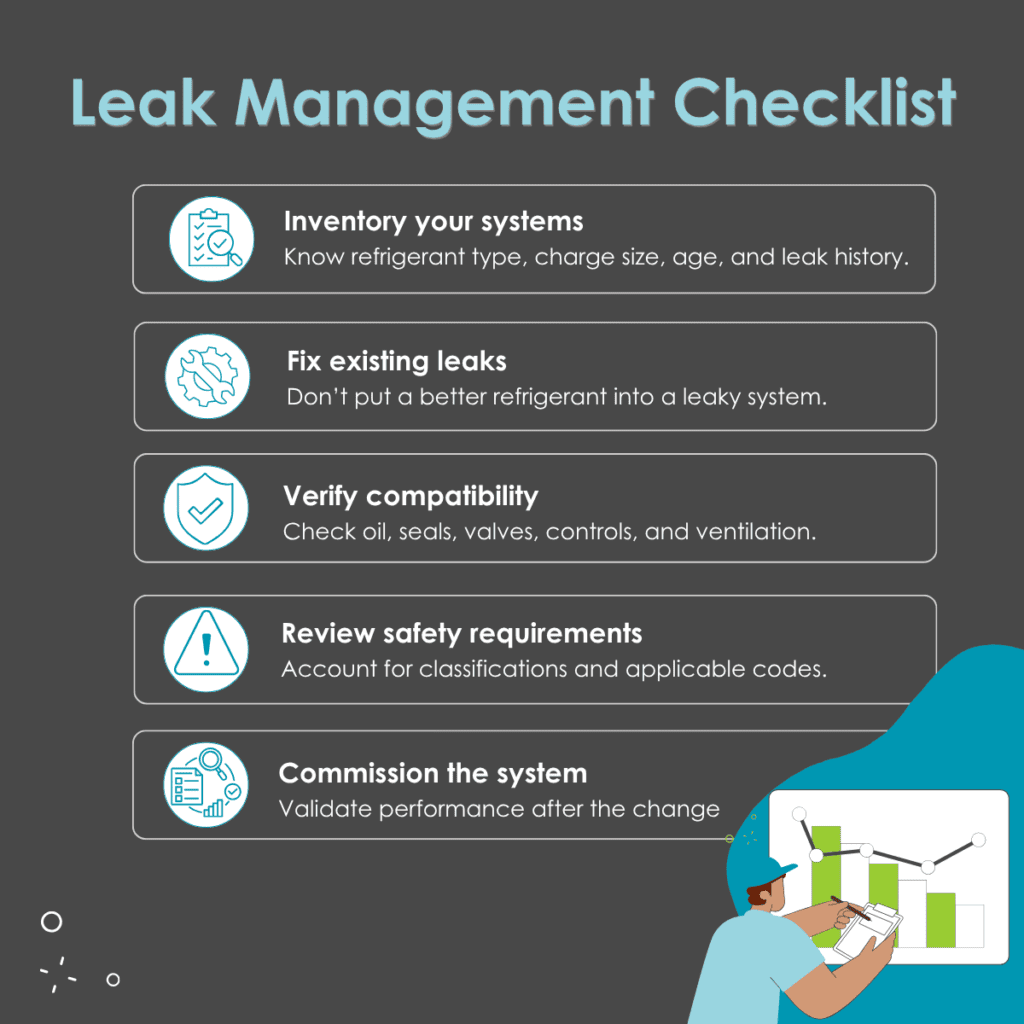
A lower-GWP refrigerant is not automatically compatible with your existing system. Capacity, discharge temperature, oil, seals, valves, and controls all need review. So do safety classifications. Your label maker is not a commissioning tool. Include the changes in the project scope before requesting a price, rather than discovering them when the system is already open. ASHRAE Standards 15 and 34 address refrigeration safety and refrigerant classification. A change in classification—including a move to a mildly flammable A2L refrigerant—requires a proper review of equipment suitability, applicable codes, detection, ventilation, and training.
Inventory the equipment, address leak tightness, validate compatibility—including lubricants, seals, expansion valves, and pressure-relief arrangements—and commission the change. Document the settings and train the people who will operate it. Otherwise, you have simply taught a leaky system to leak a different refrigerant.
Bottom Line: Stop Funding the Leak
You can put solar on the roof, thermal storage in the freezer, and a beautiful emissions chart in the boardroom. None of it gives a leaking refrigeration system a free pass. Decarbonizing the cold chain means addressing both the electricity you buy and the refrigerant you lose.
So “we topped it off” should be the beginning of the conversation—not the resolution. What leaked? What was repaired? How was the repair verified? Getting the temperature back down solves today’s emergency. Fixing the cause keeps today’s emergency from becoming next month’s standing appointment. When the gas you’re losing packs hundreds or thousands of times the climate punch of CO₂, fixing the leak isn’t housekeeping. It’s decarbonization—and “we topped it off” is definitely not a climate strategy.